Yesterday my father underwent (successful) coronary artery bypass graft surgery. In preparation for the tedium of convalescence, he bought himself an MP3 player. Among the 50 albums he loaded, he included the Piano 101 recordings. But he noted that some of the pieces that I made videos for aren't available as audio recordings. So I went back to the original audio files for those videos and encoded .wma files for downloading. Listening to them without the visual distraction of video, I was pleasantly surprised by the quality of the recording. And they capture the tone of my piano nicely. So I decided to post some of them here.
I've mentioned before that Enrique Granados' Goyescas suite is pretty much the pinnacle of piano music for me. The fourth piece in the suite is Quejas ó la Maja y el Ruiseñor (Laments or the Maiden and the Nightingale). And if you were wondering why people learn to play the piano, Maiden is a pretty good answer.
It's been a little under a year since I recorded this and I find the performance a little dry and plodding. But is it good enough to post to a blog with three readers? Most probably!
Quejas ó la Maja y el Ruiseñor (Enrique Granados)
Showing posts with label audio. Show all posts
Showing posts with label audio. Show all posts
Saturday, November 7, 2009

Tuesday, April 14, 2009
Thom Barker Band: No Forever
The second TBB demo is a song that also made it on to Twice the Usual, though with a quite different feel.
No Forever
I'll post the version off 2x as well, for comparison.
No Forever (off Twice the Usual)
The most obvious difference is the tempo. The TBB version sits just under 150 bpm. The 2x version is 180! I like the faster tempo better, but I think the slower version would have worked if we had performed it more relaxed. As it is, it sounds like we're all fighting to hold it back.
To me the second most obvious difference is how warm the TBB recording sounds. That's the difference between a real recording studio and some schlub with a home studio. The 2x version sounds very harsh by comparison. The mix on the TBB version is better too. The bass sits in the lows and doesn't stray. The electric owns the mids, and the drums find the gaps. On the 2x version, everything is fighting for the mids.
Apart from that, I think we can all agree on what the recording really needs: more cowbell!
No Forever
I'll post the version off 2x as well, for comparison.
No Forever (off Twice the Usual)
The most obvious difference is the tempo. The TBB version sits just under 150 bpm. The 2x version is 180! I like the faster tempo better, but I think the slower version would have worked if we had performed it more relaxed. As it is, it sounds like we're all fighting to hold it back.
To me the second most obvious difference is how warm the TBB recording sounds. That's the difference between a real recording studio and some schlub with a home studio. The 2x version sounds very harsh by comparison. The mix on the TBB version is better too. The bass sits in the lows and doesn't stray. The electric owns the mids, and the drums find the gaps. On the 2x version, everything is fighting for the mids.
Apart from that, I think we can all agree on what the recording really needs: more cowbell!
Sunday, April 12, 2009
Thom Barker Band: All The Same To Me
The first of the two 1996 Thom Barker Band demos was All The Same To Me.
All The Same To Me
This song has all the elements of a classic Thom Barker song: happy-catchy music, despondent lyrics, hooky Chénier guitar themes, sloppy overplayed bass and horrible backing vocals.
The first thing that jumps out at me is how over-compressed the drums are. Sure, it makes them sound nice and punchy. And it was the '90s. But man, that's a lot of compression.
Second thing is Chris' electric theme. He has this knack for coming up with a hook that's completely original, but ends up defining the song. Underneath, the acoustic and bass just repeat I-vi-IV-V (the Heart and Soul chords... and a million other pop songs). Chris' hook gives it its own character.
The bridge (at 2:03) is a departure for a Thom Barker song. I can't think of another one like it. I'm pretty sure Thom had the idea of breaking down to a half-tempo version of the chorus. I think it was also his idea to switch to 6/8 time. I do remember working it out on my SY77 sequencer to show the band how to get in and out of it. We never quite got it right, though. We got into it ok, but tended to rush the half time a little. And the band was never really comfortable coming back out. You can hear in the recording that the outro chorus is a little slower than the beginning of the song. It's maybe 8-10 bpm (about 5%) slower. The highlight of the bridge for me is Chris' harmonic embellishments. Any time he accuses me of playing too many chord extensions I can point him here. Who's the jazz-head now, eh?
All The Same To Me
This song has all the elements of a classic Thom Barker song: happy-catchy music, despondent lyrics, hooky Chénier guitar themes, sloppy overplayed bass and horrible backing vocals.
The first thing that jumps out at me is how over-compressed the drums are. Sure, it makes them sound nice and punchy. And it was the '90s. But man, that's a lot of compression.
Second thing is Chris' electric theme. He has this knack for coming up with a hook that's completely original, but ends up defining the song. Underneath, the acoustic and bass just repeat I-vi-IV-V (the Heart and Soul chords... and a million other pop songs). Chris' hook gives it its own character.
The bridge (at 2:03) is a departure for a Thom Barker song. I can't think of another one like it. I'm pretty sure Thom had the idea of breaking down to a half-tempo version of the chorus. I think it was also his idea to switch to 6/8 time. I do remember working it out on my SY77 sequencer to show the band how to get in and out of it. We never quite got it right, though. We got into it ok, but tended to rush the half time a little. And the band was never really comfortable coming back out. You can hear in the recording that the outro chorus is a little slower than the beginning of the song. It's maybe 8-10 bpm (about 5%) slower. The highlight of the bridge for me is Chris' harmonic embellishments. Any time he accuses me of playing too many chord extensions I can point him here. Who's the jazz-head now, eh?
Tuesday, February 24, 2009
Forest: Cuba
Here is Cuba.
Cuba
It's one of the few guitar+bass tracks on the album where the timing wasn't a complete mess (except at the beginning and during a couple of the breaks). It's also one of the few tracks where listening to the backing vox doesn't cause me physical pain.
I think Thom was planning to do the solo on guitar, but I had been noodling around with some Latin stuff on bass and we thought it might fit. The main bass on Cuba was my old Yamaha TRB-5p, but I played this solo was on my Steinberger XL-2A. I had the Steinberger strung up tenor (A-D-G-C) in those days because I was trying to learn Monkey Businessman off of Michael Manring's Thonk album, which had been released in 1994. Between the high tuning, the EMG pickups and the SansAmp, that bass cut through the mix like a buzzsaw. When I later replaced the TRB-5p with the TRB-JP, I was able to do both bass parts live on the same bass.
Thom played the mando himself on the track.
Cuba
It's one of the few guitar+bass tracks on the album where the timing wasn't a complete mess (except at the beginning and during a couple of the breaks). It's also one of the few tracks where listening to the backing vox doesn't cause me physical pain.
I think Thom was planning to do the solo on guitar, but I had been noodling around with some Latin stuff on bass and we thought it might fit. The main bass on Cuba was my old Yamaha TRB-5p, but I played this solo was on my Steinberger XL-2A. I had the Steinberger strung up tenor (A-D-G-C) in those days because I was trying to learn Monkey Businessman off of Michael Manring's Thonk album, which had been released in 1994. Between the high tuning, the EMG pickups and the SansAmp, that bass cut through the mix like a buzzsaw. When I later replaced the TRB-5p with the TRB-JP, I was able to do both bass parts live on the same bass.
Thom played the mando himself on the track.
Saturday, February 21, 2009
Forest: She Makes Me
The only gospel song in Thom's catalog:
She Makes Me
Ok, it's not really gospel. It's just a simple, pretty song. But the chord progression (I-III-IV-I) screams gospel to me, and I wasn't able to resist pulling out a bag of gospel clichés in the piano and organ parts.
This is one of the few songs on the album where the feel isn't too rushed. Somehow we were able to relax on this one. But the lead vocal needs to be dragged a little. Nowadays, you'd just nudge the vocal track by 50 ms or so. I did this to the lead vocal on Life is a Circle off of Twice the Usual. It completely relaxes the vocal part. But in 1995, recording to analog tape, you did the best you could and lived with it.
The piano (E-mu PROFormance again) and organs (Roland JV-1080) were tracked separately (they're different parts). But when we played this song live, I would just layer the E-mu with the XP-50 and it came out pretty close to the same thing. I still like the organ sound for the solo, but dislike the main background organ sound in the verses.
And I still really like the gospel organ solo (starting at 2:58). It's just one B3 cliché after another. In particular I'm digging the four descending "blue" figures starting at 3:34.
On the down side, there's too much compression again on the acoustic guitar. I wonder why we thought we needed it. And the doppler effect of the Leslie simulation on the B3 organ just makes it seem out of tune. (A Leslie is a speaker that spins around inside a cabinet. It adds tremolo because the speaker is alternately louder (facing you) and quieter (facing away). It also adds vibrato because the speaker is sometimes moving towards you and sometimes away from you, causing a rise and fall in pitch like an approaching/retreating ambulance siren). In hindsight, I probably should have just turned off the Leslie simulation. (For the record, this is also why the organ at the end of Even After All This Time from Twice the Usual sounds out of tune).
The timing gets sloppy at the end, too.
But overall, a pretty cool song.
She Makes Me
Ok, it's not really gospel. It's just a simple, pretty song. But the chord progression (I-III-IV-I) screams gospel to me, and I wasn't able to resist pulling out a bag of gospel clichés in the piano and organ parts.
This is one of the few songs on the album where the feel isn't too rushed. Somehow we were able to relax on this one. But the lead vocal needs to be dragged a little. Nowadays, you'd just nudge the vocal track by 50 ms or so. I did this to the lead vocal on Life is a Circle off of Twice the Usual. It completely relaxes the vocal part. But in 1995, recording to analog tape, you did the best you could and lived with it.
The piano (E-mu PROFormance again) and organs (Roland JV-1080) were tracked separately (they're different parts). But when we played this song live, I would just layer the E-mu with the XP-50 and it came out pretty close to the same thing. I still like the organ sound for the solo, but dislike the main background organ sound in the verses.
And I still really like the gospel organ solo (starting at 2:58). It's just one B3 cliché after another. In particular I'm digging the four descending "blue" figures starting at 3:34.
On the down side, there's too much compression again on the acoustic guitar. I wonder why we thought we needed it. And the doppler effect of the Leslie simulation on the B3 organ just makes it seem out of tune. (A Leslie is a speaker that spins around inside a cabinet. It adds tremolo because the speaker is alternately louder (facing you) and quieter (facing away). It also adds vibrato because the speaker is sometimes moving towards you and sometimes away from you, causing a rise and fall in pitch like an approaching/retreating ambulance siren). In hindsight, I probably should have just turned off the Leslie simulation. (For the record, this is also why the organ at the end of Even After All This Time from Twice the Usual sounds out of tune).
The timing gets sloppy at the end, too.
But overall, a pretty cool song.
Friday, February 20, 2009
Forest: Could Have Been
Here's where things start to get a little scruffy.
Could Have Been
I really like the lyrics for this song. At first blush, they're positive: the verses are full of pleasant imagery and the chorus has explicitly positive phrases. But the "it could have been" raises doubt, making the ultimate message ambiguous.
Marty Jones suggested the crashing surf sound during the chorus. He happened to have just that sound in some sample library and triggered it directly from a button the front panel of the rack-mount sampler. I think I ruined this song for Thom some time later when I suggested it sounded more like a toilet flushing and he wasn't able subsequently to shake that impression. It didn't help that I also used to make toilet flushing sounds when playing this live.
Thom played the electric on this. He had some flavor of Fender Stratocaster and I think a Fender Twin Reverb amp. The lead part is ok, but I don't like the sound... again it's thicker, more phlegmy than it needs to be. But I love the sound of the rhythm electric (the part is in the chorus, hidden under the surf sound, and is mixed pretty low).
Technically, the recording is a mess. The acoustic sounds like it was recorded with a cheap mic (which I'm sure it wasn't) in the bathroom (which I know it wasn't). The timing of the bass part is terrible. The backing vox are cringetastic. And the tuning is just way off, all around. It's shocking how bad the tuning is on the whole album, really. I think I'll do a whole post on tuning and intonation (and all the work that went into it on Twice the Usual).
Could Have Been
I really like the lyrics for this song. At first blush, they're positive: the verses are full of pleasant imagery and the chorus has explicitly positive phrases. But the "it could have been" raises doubt, making the ultimate message ambiguous.
Marty Jones suggested the crashing surf sound during the chorus. He happened to have just that sound in some sample library and triggered it directly from a button the front panel of the rack-mount sampler. I think I ruined this song for Thom some time later when I suggested it sounded more like a toilet flushing and he wasn't able subsequently to shake that impression. It didn't help that I also used to make toilet flushing sounds when playing this live.
Thom played the electric on this. He had some flavor of Fender Stratocaster and I think a Fender Twin Reverb amp. The lead part is ok, but I don't like the sound... again it's thicker, more phlegmy than it needs to be. But I love the sound of the rhythm electric (the part is in the chorus, hidden under the surf sound, and is mixed pretty low).
Technically, the recording is a mess. The acoustic sounds like it was recorded with a cheap mic (which I'm sure it wasn't) in the bathroom (which I know it wasn't). The timing of the bass part is terrible. The backing vox are cringetastic. And the tuning is just way off, all around. It's shocking how bad the tuning is on the whole album, really. I think I'll do a whole post on tuning and intonation (and all the work that went into it on Twice the Usual).
Sunday, February 15, 2009
Forest: Why
This is another one of my favorite songs, and one of Thom's saddest songs for me. Obviously, there's a lot of competition for that title. But Why is sad in a different way. It doesn't have the angry hurt of some of the others. The calm, detached acceptance in this one is what makes it go deeper.
Why
If I remember correctly, Thom had a basic chord outline and asked me to write a piano part. Unlike others that ended up keyboard-only, Thom planned that this one would be from the git-go. In fact he may have come up with the original structure on piano. But my memory is a little fuzzy on that.
The take is ok... but it's still obviously done under the stress of pay-by-the-hour professional studio time. It's just not relaxed and there is some sloppy timing. The piano take for Down By Your Fire is better in this regard, but I had been playing Fire for years, whereas my Why part was only a week or so old when we recorded it. Once again, the piano is the E-mu PROFormance/1+, and it's not bad, even out there by itself.
I think three things give the piano part its particular character:
Why
If I remember correctly, Thom had a basic chord outline and asked me to write a piano part. Unlike others that ended up keyboard-only, Thom planned that this one would be from the git-go. In fact he may have come up with the original structure on piano. But my memory is a little fuzzy on that.
The take is ok... but it's still obviously done under the stress of pay-by-the-hour professional studio time. It's just not relaxed and there is some sloppy timing. The piano take for Down By Your Fire is better in this regard, but I had been playing Fire for years, whereas my Why part was only a week or so old when we recorded it. Once again, the piano is the E-mu PROFormance/1+, and it's not bad, even out there by itself.
I think three things give the piano part its particular character:
- the use of sixths and ninths all over the place
- splitting four-note chords into two consecutive two-note chords (first and third note in one, second and fourth in the other); this adds rhythm and opens up what would otherwise be more dense voicing
- horizontal and vertical "shifting" of the split chords; vertically there is shifting among different inversions of the chords up and down the keyboard; the solo is really just different shifts of figures already played in the chorus; horizontally, the split chords shift to different beats in subsequent bars and also shift off the beat occasionally
Thursday, February 12, 2009
Forest: I Know Me
There's lots I like about this song, and plenty I don't like about the recording. But the former definitely trumps the latter for me.
I Know Me
The song also has a special significance for me. When we recorded this in August, 1995, Johanne and I had been dating for about four months. But our pre-dating "courtship" took place over winter 94-95. We were Ph.D. students together at the University of Ottawa, with the Rideau Canal just outside our office. Most days, after work we'd lace up and go for a skate down the canal in the dark, getting to know each other, falling in love. The line:
Thom's voice kind of cracks on the word "free" at 3:31; I remember lobbying to re-record the line, but we left it in. I don't remember why we did, but to this day it's my favorite moment of any recording of Thom's vocal. It's raw emotion in a song that's already emotional for me and I honestly still get a chill when I hear it.
As for the technical side...
There's way too much compression on the acoustic guitar; this sparse arrangement didn't really need much.
I think I came up with the string parts in the studio. We decided the track needed something extra. Marty found violin and cello patches on the Roland JV-1080 and I noodled for a bit and then recorded them. They're simple and they build verse-by-verse until dropping out to let Thom finish alone. I like the counter-melody they add.
We also re-recorded this in a more radio-friendly arrangement a few years ago when Thom was still in Austin. I should try to find the newer version.
I Know Me
The song also has a special significance for me. When we recorded this in August, 1995, Johanne and I had been dating for about four months. But our pre-dating "courtship" took place over winter 94-95. We were Ph.D. students together at the University of Ottawa, with the Rideau Canal just outside our office. Most days, after work we'd lace up and go for a skate down the canal in the dark, getting to know each other, falling in love. The line:
And where ice on Rideau Canal lightscan still make me mist up a little.
Glistens in skating lovers' laughin' eyes
Thom's voice kind of cracks on the word "free" at 3:31; I remember lobbying to re-record the line, but we left it in. I don't remember why we did, but to this day it's my favorite moment of any recording of Thom's vocal. It's raw emotion in a song that's already emotional for me and I honestly still get a chill when I hear it.
Where the snow flies free,It's the only cold weather imagery that makes me miss the Canadian winter.
Where the cold cuts the skin...
As for the technical side...
There's way too much compression on the acoustic guitar; this sparse arrangement didn't really need much.
I think I came up with the string parts in the studio. We decided the track needed something extra. Marty found violin and cello patches on the Roland JV-1080 and I noodled for a bit and then recorded them. They're simple and they build verse-by-verse until dropping out to let Thom finish alone. I like the counter-melody they add.
We also re-recorded this in a more radio-friendly arrangement a few years ago when Thom was still in Austin. I should try to find the newer version.
Sunday, February 8, 2009
Forest: Down By Your Fire
Down By Your Fire was the last song on Forest. But I'm blogging it first because I think I think it's the best track on the album.
Down By Your Fire
This is a great song. A great, great song. Thom used to play it with guitar only. And we played a guitar + piano version on the Regent Street album (1991). Listening back to the Regent Street version, I notice that some of the Forest piano part was already in place. Over time I started adding more of Thom's guitar part on piano and eventually he stopped playing guitar on the song altogether.
The instrumental part is much more relaxed than other tracks on the album, and has better time and feel. It's probably because I'd had the part under my hands for years by the time we recorded it (in contrast with the song Why, where the piano part was written just prior to recording it).
The keyboard sound is my E-mu PROFormance/1+ layered with my Roland D-50. The PROFormance piano sound can't really compete with modern, multi-layer, disk-streamed, non-looped, gigabyte sampled grands. But it actually holds up ok in this context, even out there all on its own. I guess the one part of the sound that bugs me is the ridiculous sustain. But in 1995, this was a really good piano-in-a-box (and it was already five years old at the time).
It seems I have some deficiency that renders me incapable of finishing a song on a straight major chord. I have to play the ninth. Chris Chénier's wife Nathalie once asked him after one of our shows: "Why does Ken always play that funny note at the end of every song?"
I miss playing this song with Thom.
Down By Your Fire
This is a great song. A great, great song. Thom used to play it with guitar only. And we played a guitar + piano version on the Regent Street album (1991). Listening back to the Regent Street version, I notice that some of the Forest piano part was already in place. Over time I started adding more of Thom's guitar part on piano and eventually he stopped playing guitar on the song altogether.
The instrumental part is much more relaxed than other tracks on the album, and has better time and feel. It's probably because I'd had the part under my hands for years by the time we recorded it (in contrast with the song Why, where the piano part was written just prior to recording it).
The keyboard sound is my E-mu PROFormance/1+ layered with my Roland D-50. The PROFormance piano sound can't really compete with modern, multi-layer, disk-streamed, non-looped, gigabyte sampled grands. But it actually holds up ok in this context, even out there all on its own. I guess the one part of the sound that bugs me is the ridiculous sustain. But in 1995, this was a really good piano-in-a-box (and it was already five years old at the time).
It seems I have some deficiency that renders me incapable of finishing a song on a straight major chord. I have to play the ninth. Chris Chénier's wife Nathalie once asked him after one of our shows: "Why does Ken always play that funny note at the end of every song?"
I miss playing this song with Thom.
Tuesday, May 27, 2008
Piano 101: 10. Sonetto 104 del Petrarca
Franz Liszt published some of his greatest solo piano music in three volumes he called Années de Pèlerinage (Years of Pilgrimage). The second year ("Italy") includes three pieces inspired by the Italian poet Petrarch. Sonetto 104 del Petrarca will be my final recording in this series. So sad.
The piece is one of my all-time favorites. It really showcases the piano, with singing melody, percussion, lush orchestral voicing and shimmering effects. I loved playing it years ago and I love it even more now.
Track 10: Sonetto 104 del Petrarca (Franz Liszt)
The piece is one of my all-time favorites. It really showcases the piano, with singing melody, percussion, lush orchestral voicing and shimmering effects. I loved playing it years ago and I love it even more now.
Track 10: Sonetto 104 del Petrarca (Franz Liszt)
Sunday, May 11, 2008
Piano 101: 9. Toccata pour le Piano Opus 54
Jenö Takács was a twentieth century Austrian composer. According to my Austrian edition (Doblinger), this piece was written in 1946. The metronome marking is 96-108 half notes per minute. And as if anticipating our disbelief, the composer also notes that the total performance time is around four minutes. The composer's insistence notwithstanding, I couldn't bring myself to record it that fast. So my version has parts that get up to 96, but mostly hangs down in the low 90s or high 80s.
I decided to include this piece because my uncle Marty liked it so much. He came to visit us in Ottawa one time and I played it for him. He suggested that after finishing the piece, I should leap up, kick over the bench, knock out the lid prop and slam down the fallboard. I never took him up on his choreography, but from that point on I couldn't play the piece without it crossing my mind.
Track 9: Toccata pour le Piano Opus 54 (Jenö Takács)
I decided to include this piece because my uncle Marty liked it so much. He came to visit us in Ottawa one time and I played it for him. He suggested that after finishing the piece, I should leap up, kick over the bench, knock out the lid prop and slam down the fallboard. I never took him up on his choreography, but from that point on I couldn't play the piece without it crossing my mind.
Track 9: Toccata pour le Piano Opus 54 (Jenö Takács)
Saturday, April 26, 2008
Piano 101: 8. Impromptu Opus 90 Nr. 4
I broke the rules on this one. These were supposed to be recordings of pieces I used to play many years ago, but I never played this one before this year.
Schubert's Impromptu is a piece that my mother used to play. Some of my earliest memories are of her playing it on her old Chopin upright piano. I couldn't have been more than four or five years old. But it was one of the pieces that got me interested in learning the piano and has stuck with me all these years.
I'm sure my father will recognize this piece, and probably my brothers and sister, too. But I wonder if any of my mother's brothers and sisters remember her playing it. I would love to hear any reminiscences.
Track 8: Impromptu Opus 90 Nr. 4 (Franz Schubert)
Schubert's Impromptu is a piece that my mother used to play. Some of my earliest memories are of her playing it on her old Chopin upright piano. I couldn't have been more than four or five years old. But it was one of the pieces that got me interested in learning the piano and has stuck with me all these years.
I'm sure my father will recognize this piece, and probably my brothers and sister, too. But I wonder if any of my mother's brothers and sisters remember her playing it. I would love to hear any reminiscences.
Track 8: Impromptu Opus 90 Nr. 4 (Franz Schubert)
Sunday, March 23, 2008
Piano 101: 7. Arabesque I
Debussy's Arabesque I was probably the first piece I learned that you'd consider "concert repertoire". It must have been around 1982 or 1983, I think. The piece is an example of French Impressionist music, known for its suggestion of atmosphere. But I had a lot of trouble trying to capture the tranquility and mood in a recording. Nonetheless, it's one of my all-time favorite pieces to play. It feels like making music.
Track 7: Arabesque I (Claude Debussy)
Track 7: Arabesque I (Claude Debussy)
Friday, March 7, 2008
Piano 101: 6. Danza del Gaucho Matrero
The final Argentinian Dance is the Dance of the Cunning Cowboy. The opening instruction on the score is "Furiosamente ritmico e energico" ("furiously rhythmic and energetic"), and it doesn't let up from beginning to end. You really have to work out how to keep the energy up without hammering on every note, because your arms won't make it to the end. I've found that stressing the inner voices in the big chords gives power and brings out the melody while avoiding exhaustion.
There are plenty of examples of the 2x3 vs. 3x2 rhythm throughout, as well as a new twist in the chordal melody sections where Ginastera inserts some bars of 9/8 among the 6/8. That adds a 3x3 grouping to the mix. There are a few other bizarre accent patterns that can completely throw your timing if you're not careful.
Anyway. Strap on your seatbelt...
Track 6: Danza del Gaucho Matrero (Alberto Ginastera)
There are plenty of examples of the 2x3 vs. 3x2 rhythm throughout, as well as a new twist in the chordal melody sections where Ginastera inserts some bars of 9/8 among the 6/8. That adds a 3x3 grouping to the mix. There are a few other bizarre accent patterns that can completely throw your timing if you're not careful.
Anyway. Strap on your seatbelt...
Track 6: Danza del Gaucho Matrero (Alberto Ginastera)
Wednesday, January 30, 2008
Piano 101: 5. Danza de la Moza Donosa
The second of Ginastera's Argentinian Dances is the Dance of the Graceful Maiden. And I LOVE this piece... the close chromaticism in the melody... the wide open intervals in the harmony.
There isn't a lot of rhythmic action, but a classic accent figure from Spanish music appears a couple of times. The 6/8 bars are mostly accented 1-2-3-1-2-3 but Ginastera occasionally throws in a bar accented 1-2-1-2-1-2. The most obvious examples are at 1:29 and 2:01. You can hear the effect by reciting this little poem:
Muffin with Marmelade
Muffin with Marmelade
Muffin with Marmelade
Muffin Muffin Muffin
This figure also appears all over the place in Albéniz' El Puerto and in the other two Argentinian Dances.
Track 5: Danza de la Moza Donosa (Alberto Ginastera)
There isn't a lot of rhythmic action, but a classic accent figure from Spanish music appears a couple of times. The 6/8 bars are mostly accented 1-2-3-1-2-3 but Ginastera occasionally throws in a bar accented 1-2-1-2-1-2. The most obvious examples are at 1:29 and 2:01. You can hear the effect by reciting this little poem:
Muffin with Marmelade
Muffin with Marmelade
Muffin with Marmelade
Muffin Muffin Muffin
This figure also appears all over the place in Albéniz' El Puerto and in the other two Argentinian Dances.
Track 5: Danza de la Moza Donosa (Alberto Ginastera)
Saturday, January 19, 2008
Piano 101: 4. Danza del Viejo Boyero
Or Dance of the Old Cowherd, although I can't imagine anybody dancing to this piece, much less an old cowherd.
Viejo Boyero is the first of three pieces that make up Alberto Ginastera's Danzas Argentinas. These three were among the last pieces I studied with Douglas Voice.
Listen for the six long notes at the end: they're the notes of the six open strings of a guitar.
Track 4: Danza del Viejo Boyero (Alberto Ginastera)
Viejo Boyero is the first of three pieces that make up Alberto Ginastera's Danzas Argentinas. These three were among the last pieces I studied with Douglas Voice.
Listen for the six long notes at the end: they're the notes of the six open strings of a guitar.
Track 4: Danza del Viejo Boyero (Alberto Ginastera)
Sunday, January 6, 2008
Piano 101: 3. Villanesca
Villanesca was probably my first exposure to the Spanish piano repertoire. My score has pencil markings from both Edith Orton and Jean-Paul Sevilla, suggesting that I worked on this piece toward the very end of my time with Mrs. Orton. That's when she was sending me occasionally to study with Jean-Paul and Douglas. Probably around 1984.
There's something so compelling about the mood of this piece to me. I always come back to it, and it always affects me. I think it's probably a combination of the stately, foreign sounds and my history with the piece.
I never studied much of the story of Enrique Granados. I know he was a Catalonian composer from around the turn of the century (19th to 20th). He's best known for his Goyescas suite, not the Spanish Dances suite from which Villanesca comes. I might get around to recording one of the Goyescas pieces eventually. We'll see.
Track 3: Villanesca (Enrique Granados)
There's something so compelling about the mood of this piece to me. I always come back to it, and it always affects me. I think it's probably a combination of the stately, foreign sounds and my history with the piece.
I never studied much of the story of Enrique Granados. I know he was a Catalonian composer from around the turn of the century (19th to 20th). He's best known for his Goyescas suite, not the Spanish Dances suite from which Villanesca comes. I might get around to recording one of the Goyescas pieces eventually. We'll see.
Track 3: Villanesca (Enrique Granados)
Tuesday, January 1, 2008
Piano 101: 2. Étude Opus 10 Nr. 3
If I had to guess, I'd say the piece I performed the most over the years was this Chopin Étude. Its nickname is "Tristesse", but I don't really find it sad. Maybe it's a little wistful.
The Chopin Études were intended to present technical exercises to students in the natural setting of enjoyable music. Chopin accomplished this blend so successfully that the Études have become part of the solo piano concert repertoire. The exercise in this piece is right-hand self-accompaniment. The right hand is playing two parts simultaneously: the obvious melody and a chordal accompaniment. The goal is to make the melody sing, standing out from the accompaniment, even though they're being played with one hand.
Track 2: Étude Opus 10 Nr. 3 (Frédéric Chopin)
The Chopin Études were intended to present technical exercises to students in the natural setting of enjoyable music. Chopin accomplished this blend so successfully that the Études have become part of the solo piano concert repertoire. The exercise in this piece is right-hand self-accompaniment. The right hand is playing two parts simultaneously: the obvious melody and a chordal accompaniment. The goal is to make the melody sing, standing out from the accompaniment, even though they're being played with one hand.
Track 2: Étude Opus 10 Nr. 3 (Frédéric Chopin)
Friday, December 28, 2007
Piano 101: 1. El Puerto
Ok. I had another goal in getting back to the piano. I wanted to build my playing back up well enough to record my old repertoire for my parents. They had to listen to me practice this stuff every day. At the time they were probably sick of hearing it. But it's been almost 20 years, and I thought it would be nice for them to have a record of me playing again. The full project will take me a while, so the recordings will probably come slowly. But the first rough track is here.
I chose to do El Puerto, from Isaac Albéniz' Iberia Suite first. It was one of my favorite pieces to perform, and probably my favorite piece of piano music, period. It could use some polish, but here it is.
Track 1: El Puerto (Isaac Albéniz)
I chose to do El Puerto, from Isaac Albéniz' Iberia Suite first. It was one of my favorite pieces to perform, and probably my favorite piece of piano music, period. It could use some polish, but here it is.
Track 1: El Puerto (Isaac Albéniz)
Tuesday, December 4, 2007
2x: 11. Say Goodnight
So here we are at the end already. Last song. So sad.
Track 11: Say Goodnight
Thom's songwriting journal entry for Say Goodnight
Virtual Ensemble
It may be kind of obvious, but we always used to do "Say Goodnight" as the last song of the night when we were playing live, so that's how I always think of this song: live and last.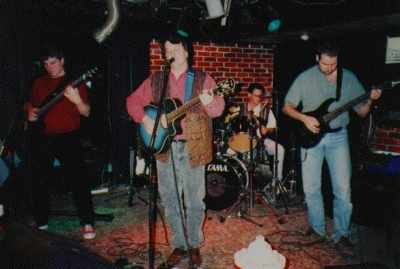 Making it the last was easy: put it after all the other songs. Making it "live" required a few tricks. The biggest issue was trying to make it different from the other tracks but still fit with the sound of the album.
In many places on the album I already had ideas for electric parts. For those, I'd email Chris trying to "textify" my idea. Somehow, no matter how ridiculous my instructions, he'd always lay down exactly what I had in mind. Here were my instructions for Say Goodnight:
...
Chug...ga-Chug...ga-Chug...ga-Chug-gaga-
Chug...ga-Chugschwinnnngg..ga-Chug-gaga-
"I"
CHANNNNNNNNNNNNNG!
"Say"
CHANNNNNNNNNNNNNG!
"Goodnight"
buh-Changuk... buh-ChangGannnnnnnng
...
The yelling in the chorus was also something we used to do live. So for the album I recorded myself about ten times yelling "I" and "SAY". But when I mixed the yells in with the music, for some reason it sounded like "Oy... Soy". When I played back the yells in isolation they were fine. So some weird interaction, frequency masking, reverb artifact, or combination of these was messing with the harmonic content. I ended up having to put on a high-pass filter, remove all the reverb and replace half of the "I... Say" parts with "Ah-ee... Sah-ee". Strange but true.
Coming Soon: 2x: Appendices
Track 11: Say Goodnight
Thom's songwriting journal entry for Say Goodnight
Virtual Ensemble
- A.V.: acoustic guitar, lead vocal
- B.B.: bass, background vocal
- K.B.: rhythm electric guitar
- E.G.: lead electric guitar
- D.P.: drums
- Thom Barker: acoustic guitar, lead vocal
- Ken Barker: fretted bass (BEADGC), drum programming, background vocal
- Christian Chénier: electric guitars
It may be kind of obvious, but we always used to do "Say Goodnight" as the last song of the night when we were playing live, so that's how I always think of this song: live and last.
 Making it the last was easy: put it after all the other songs. Making it "live" required a few tricks. The biggest issue was trying to make it different from the other tracks but still fit with the sound of the album.
- The most obvious "live" trick is the bar noises at the beginning and end. Even without any other tricks, this primes the listener into thinking "live".
- Another fairly obvious trick is the extra effects on the lead vocal. I put a short echo and extra reverb to sound like a loud PA system in a closed space.
- The drums are also quite different from the other tracks. I was out at Cedar Street one night listening to a great funk band, trying to put my finger on what made the drums sound so "live". The combination of mics, eq, amps, speakers and gobs of compression make them sound much more artificial. I tried reproducing that signal path virtually, but the Yellow Tools drums I used on the album are so acoustic sounding that it was a real struggle to color them enough. I needed to start from a more artificial source. If found some sampled drums on my Roland XP-50 keyboard that were just right. So I replaced the kick, snare and toms with the XP-50 samples. I kept the natural sounding hats, ride and cymbals from Yellow Tools -- the XP-50 metals were just too fake. I think the result sounds pretty close to a kit through a live PA.
- There's a spot near the end where it sounds like the guitar feeds back for a second (around 5:14). I'm not sure what's causing this sonic effect, but it adds to the live sound, so I left it in.
- The sparse applause at the end is reminiscent of some of the shows we did with... uh... "modest" attendance. I remember one show at The Pit in Ottawa during a snow storm in December. Beyond the barstaff and significant others, I'm not sure anyone else was there. Sure... we can laugh about it now.
- Light dimmers and questionable electrical at bars is always causing something to buzz. I recorded the amp buzz at the end by running my bass amp through the system while holding the free end of the patch cord in my fingers. I had to record the amp shutting off separately because it's such a loud pop that everything downstream in the signal path has to be trimmed.
In many places on the album I already had ideas for electric parts. For those, I'd email Chris trying to "textify" my idea. Somehow, no matter how ridiculous my instructions, he'd always lay down exactly what I had in mind. Here were my instructions for Say Goodnight:
...
Chug...ga-Chug...ga-Chug...ga-Chug-gaga-
Chug...ga-Chugschwinnnngg..ga-Chug-gaga-
"I"
CHANNNNNNNNNNNNNG!
"Say"
CHANNNNNNNNNNNNNG!
"Goodnight"
buh-Changuk... buh-ChangGannnnnnnng
...
The yelling in the chorus was also something we used to do live. So for the album I recorded myself about ten times yelling "I" and "SAY". But when I mixed the yells in with the music, for some reason it sounded like "Oy... Soy". When I played back the yells in isolation they were fine. So some weird interaction, frequency masking, reverb artifact, or combination of these was messing with the harmonic content. I ended up having to put on a high-pass filter, remove all the reverb and replace half of the "I... Say" parts with "Ah-ee... Sah-ee". Strange but true.
Coming Soon: 2x: Appendices
Subscribe to:
Posts (Atom)


 Posts
Posts

