When I decided to start practicing again and build a program, I had no idea how obsessed I would become with the piano. I want to play them all.
I've had fun practicing, performing a little and recording some pieces to post here for family and friends. It's all been an absolute joy for me.
Hanging out at the Steinway Gallery was a roller coaster. Playing all those great pianos was a real high, but there was no way I would ever be able to get one. The less expensive Bostons were beautiful, but still out of reach. And there was no shortage of other good pianos I couldn't afford either. I finally got curious enough to ask about Steinway's relatively inexpensive "third string" line: the Essex. Like the "second string" Boston, these are pianos that are designed and sold by Steinway, but manufactured for them in Asia: Boston by Kawai in Japan and Essex by Young Chang in Korea (with one or two models built in China by Pearl River).
The biggest Essex is the 183, at just a sliver over six feet. It shares many of the design features of the Bostons and Steinways, including the wide tail of the four longest Steinways. I was really impressed with the 183, although the voicing and action of the floor model was a little uneven. When I mentioned it to my Steinway guy, he said he'd have his tech do some work on it. Over the next month, I went in every weekend to play it and give my impressions. And every week the tech would work on it some more. The tone and playability turned out exceptional. So the Steinway Gallery ended up with a floor piano set up exactly to my tastes... and a piano that I couldn't live without.
After more financing obstacles than I care to rehash, giving up expensive coffee, Trappist beer and ice hockey, I was able to work it out. Steinway delivers my brand new Essex EGP-183 tomorrow morning. My own piano. I'm so excited, I think I will barf.
So even though Piano 101 has come to an end, I expect that my new piano will inspire many posts to come. Stay tuned!
Showing posts sorted by relevance for query piano 101. Sort by date Show all posts
Showing posts sorted by relevance for query piano 101. Sort by date Show all posts
Thursday, May 29, 2008

Monday, December 17, 2007
Piano 101: Ancient History
My mother is a piano teacher, so we've always had lots of piano music in the house. I remember sitting on the floor at her feet under the keybed of her old "Chopin" upright piano while she played. When I was old enough to reach the keys I started plunking out stuff myself. With my mother's help I began to make my way through the lesson books. This informal arrangement lasted for maybe five years, I'm guessing. I had stumbled my way to about a grade 5 level in the Royal Conservatory of Music (Toronto) grading system. We decided that if I wanted to "do it right", I needed a teacher. So at ten years old I began formal lessons with Edith Orton, a great Ottawa teacher.
Mrs. Orton guided me through the Royal Conservatory examinations until RCM grade 10. Along the way she encouraged me to perform in recitals and compete at the Ottawa Music Festival and the Canadian Music Competition. My repertoire was mostly from the RCM examniation syllabi, but also included, importantly, concerti for piano and orchestra. My orchestra was my mother, playing the orchestra parts arranged for second piano. As I advanced through the grades, Mrs. Orton also stressed the importance of occasional lessons with other teachers. I had the opportunity to meet with Jean-Paul Sevilla, Andrew Tunis and Douglas Voice, all three at the University of Ottawa at the time. But more than anyone else, Edith Orton taught me music, and I'm forever indebted to her for it.
After grade 10, Mrs. Orton decided I would benefit more by getting a new teacher. The obvious best fit was Douglas Voice at UofO. I think I must have been about 17 years old and probably starting grade 12 at High School. (High School in Ontario at the time went to grade 13). My two years of lessons with Douglas Voice prepared me for the ultimate Royal Conservatory exam: the Associateship Diploma in Piano Performance. Creative planning of my High School course schedule over the years allowed me to finish grade 13 spending only a half day at school. The other half I could spend practicing.
My lessons with Douglas were completely different from previous lessons. We would often spend our time discussing issues of interpretation or experimenting with different sounds and techniques to decide what might work for a given piece. I took the Associateship exam in the Spring of 1986, the same time I graduated from High School. I thank Douglas for bringing me to the "next level" of performance, and for introducing me to an incredible new world in the piano repertoire -- in particular the Spanish piano works of Granados, Albeniz and Ginastera.
After High School I had a bit of a premature mid-life crisis. I had always assumed I would find some kind of career in music. When I realized I didn't want to get a BMus, it became obvious that my options were pretty limited. I panicked. I got into computers. During the musical winter of my computer studies, I did manage to spend one semester at the piano, fulfilling a Humanities credit by doing a juried recital course in piano performance. It gave me the opportunity to study once more with Douglas Voice, one-on-one for the semester. We remained good friends, but that would be the last time we studied music together. Douglas succumbed to cancer in 1998. I wish I could play for him one more time.
Mrs. Orton guided me through the Royal Conservatory examinations until RCM grade 10. Along the way she encouraged me to perform in recitals and compete at the Ottawa Music Festival and the Canadian Music Competition. My repertoire was mostly from the RCM examniation syllabi, but also included, importantly, concerti for piano and orchestra. My orchestra was my mother, playing the orchestra parts arranged for second piano. As I advanced through the grades, Mrs. Orton also stressed the importance of occasional lessons with other teachers. I had the opportunity to meet with Jean-Paul Sevilla, Andrew Tunis and Douglas Voice, all three at the University of Ottawa at the time. But more than anyone else, Edith Orton taught me music, and I'm forever indebted to her for it.
After grade 10, Mrs. Orton decided I would benefit more by getting a new teacher. The obvious best fit was Douglas Voice at UofO. I think I must have been about 17 years old and probably starting grade 12 at High School. (High School in Ontario at the time went to grade 13). My two years of lessons with Douglas Voice prepared me for the ultimate Royal Conservatory exam: the Associateship Diploma in Piano Performance. Creative planning of my High School course schedule over the years allowed me to finish grade 13 spending only a half day at school. The other half I could spend practicing.
My lessons with Douglas were completely different from previous lessons. We would often spend our time discussing issues of interpretation or experimenting with different sounds and techniques to decide what might work for a given piece. I took the Associateship exam in the Spring of 1986, the same time I graduated from High School. I thank Douglas for bringing me to the "next level" of performance, and for introducing me to an incredible new world in the piano repertoire -- in particular the Spanish piano works of Granados, Albeniz and Ginastera.
After High School I had a bit of a premature mid-life crisis. I had always assumed I would find some kind of career in music. When I realized I didn't want to get a BMus, it became obvious that my options were pretty limited. I panicked. I got into computers. During the musical winter of my computer studies, I did manage to spend one semester at the piano, fulfilling a Humanities credit by doing a juried recital course in piano performance. It gave me the opportunity to study once more with Douglas Voice, one-on-one for the semester. We remained good friends, but that would be the last time we studied music together. Douglas succumbed to cancer in 1998. I wish I could play for him one more time.
Sunday, December 16, 2007
Piano 101: I Need a Piano
Luckily, it's pretty easy for me to get my hands on practice pianos. The School of Music at the University has something like 75 practice cubes with grands. So I can leave my office at lunch, put on my student disguise, walk over to the SoM and sneak into a cube. I'd say the majority are Steinway Ms, with a few Baldwins, Mason&Hamlins, etc. thrown in. Most of them are pretty small, but a few of the cubes have bigger pianos (6'-7'+). Unfortunately, all of the pianos are fairly beat-up, and many of the Steinways have problems with the sostenuto pedal. There's one Baldwin that's probably the best sounding/playing piano there, and I can usually snag it if I go at the right time. I think it must be an SF10, since I'm sure it's bigger than an L1 (the longest Artist Baldwin).
My friends Bruce and Claudia have a C3 that they're happy to let me play. So I've started bringing my music bag whenever I go over there. I'm really impressed with the way that C3 sounds in their spacious living room. It's really sweet and warm.
Of course, what I really want is a piano of my own, so I've started doing a little research. As luck would have it, the Steinway Piano Gallery is just minutes from my house, and I've been spending some time there. I told my wife I'm having an affair, because if she found out I've been going to the piano store, she'd kill me. They have a huge selection: all the Steinways (including a D in their recital hall!), some Baldwins, a few Yamahas, Bostons, Petrofs, etc. They also have various brands of PSO*. It's great to be able to play all of these side-by-side to compare tone, touch, etc. It's also kind of dangerous, because after playing a nicely set up Steinway, it's hard to get excited about some of the others. I've pretty much accepted the fact that I'll never be able to afford one, but it's nice to dream. And there are some nice pianos out there that cost less than a house.
*Piano-Shaped Object
My friends Bruce and Claudia have a C3 that they're happy to let me play. So I've started bringing my music bag whenever I go over there. I'm really impressed with the way that C3 sounds in their spacious living room. It's really sweet and warm.
Of course, what I really want is a piano of my own, so I've started doing a little research. As luck would have it, the Steinway Piano Gallery is just minutes from my house, and I've been spending some time there. I told my wife I'm having an affair, because if she found out I've been going to the piano store, she'd kill me. They have a huge selection: all the Steinways (including a D in their recital hall!), some Baldwins, a few Yamahas, Bostons, Petrofs, etc. They also have various brands of PSO*. It's great to be able to play all of these side-by-side to compare tone, touch, etc. It's also kind of dangerous, because after playing a nicely set up Steinway, it's hard to get excited about some of the others. I've pretty much accepted the fact that I'll never be able to afford one, but it's nice to dream. And there are some nice pianos out there that cost less than a house.
*Piano-Shaped Object
Monday, December 24, 2007
Piano 101: I Wish I Knew How To Quit You
I was back at the Steinway Gallery again on Saturday.
Steinway Guy emailed me to tell me he just received two new Bostons that I should check out: a 193 (6'4") and a 215 (7'). So I went in Saturday to have a look. That makes it three weeks in a row I've been in there.
The new Bostons were great. The tone on the 215 was gorgeous, and it played a lot like a Steinway B. But its action was a touch mushier than the 193. So Steinway Guy says he's going to have his tech look at the 215 to see if he can firm up the action, make it as crisp as the 193. To be honest, I'd rather his tech see if he could voice the 193 to make it as warm as the 215. (Ya, like they're going to voice a piano to the tastes of some guy who can't afford to buy it). I'm really impressed with the Bostons, though. They sound and play great at half the price of the core Steinways. Of course, even half the price is a darn expensive piano -- well above the range of the Japanese pianos.
I also played the Pramberger 228 (7'6") again. It's a nice piano, great tone. A little loose. There's a buyer in San Antonio who wants it. Steinway Guy held on to it because he knew I was coming in Saturday and I had mentioned that I liked it. I had to laugh. I told him to go ahead and send it to San Antonio.
But the star of the show remains this one Steinway A. I've probably played four or five As (6'2") and four or five Bs (6'11") at SPG. But this one A is "The One". Number 578688 (or "688", as I like to call it) may be the nicest piano under 9' that I've ever played. It does everything I ask it to do, without complaint or hesitation. It's like it wants to make me play better. And the tone is like buttah.
Ok. This is getting a little weird.
Anyway. Steinway Guy is going to email when his tech has had a go at the Boston 215. Probably later this week. That'll make it four weeks in a row. Johanne is definitely starting to get suspicious.
Steinway Guy emailed me to tell me he just received two new Bostons that I should check out: a 193 (6'4") and a 215 (7'). So I went in Saturday to have a look. That makes it three weeks in a row I've been in there.
The new Bostons were great. The tone on the 215 was gorgeous, and it played a lot like a Steinway B. But its action was a touch mushier than the 193. So Steinway Guy says he's going to have his tech look at the 215 to see if he can firm up the action, make it as crisp as the 193. To be honest, I'd rather his tech see if he could voice the 193 to make it as warm as the 215. (Ya, like they're going to voice a piano to the tastes of some guy who can't afford to buy it). I'm really impressed with the Bostons, though. They sound and play great at half the price of the core Steinways. Of course, even half the price is a darn expensive piano -- well above the range of the Japanese pianos.
I also played the Pramberger 228 (7'6") again. It's a nice piano, great tone. A little loose. There's a buyer in San Antonio who wants it. Steinway Guy held on to it because he knew I was coming in Saturday and I had mentioned that I liked it. I had to laugh. I told him to go ahead and send it to San Antonio.
But the star of the show remains this one Steinway A. I've probably played four or five As (6'2") and four or five Bs (6'11") at SPG. But this one A is "The One". Number 578688 (or "688", as I like to call it) may be the nicest piano under 9' that I've ever played. It does everything I ask it to do, without complaint or hesitation. It's like it wants to make me play better. And the tone is like buttah.
Ok. This is getting a little weird.
Anyway. Steinway Guy is going to email when his tech has had a go at the Boston 215. Probably later this week. That'll make it four weeks in a row. Johanne is definitely starting to get suspicious.
Saturday, December 15, 2007
Piano 101: The Next Project
I used to play the piano a lot. Then came the usual combination of distractions: school, work, life. I always made time for music, but the Big Hand and Twice the Usual recording commitments ate up my whole music time budget. 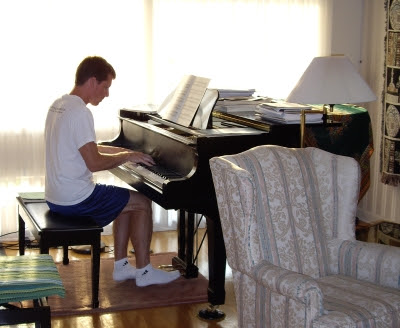 In August this year, I finally convinced myself to call the Twice the Usual album "finished", and was starting to wonder what musical pursuit would take its place. The Antonini family reunion would give me the answer.
The Antoninis are a very musical family, my uncle Marty the most conspicuously so. At any gathering someone will eventually say "Hey Marty, go get your piano!", and he'll show up 15 minutes later with a PA. He's probably the most entertaining entertainer I've ever seen. His ability to perform on demand is inspiring, and I realized that I regretted not being able to play when asked. In spite of all the time I've spent in the studio over the last ten years, I didn't have a single thing on any instrument that I could sit down and play from beginning to end. So I vowed to "learn how to play the piano again."
In this next part of the Art Facts blog I'll write about my reintroduction to the piano, and the path back to playing in public. And I'll post some recordings along the way, too.
 In August this year, I finally convinced myself to call the Twice the Usual album "finished", and was starting to wonder what musical pursuit would take its place. The Antonini family reunion would give me the answer.
The Antoninis are a very musical family, my uncle Marty the most conspicuously so. At any gathering someone will eventually say "Hey Marty, go get your piano!", and he'll show up 15 minutes later with a PA. He's probably the most entertaining entertainer I've ever seen. His ability to perform on demand is inspiring, and I realized that I regretted not being able to play when asked. In spite of all the time I've spent in the studio over the last ten years, I didn't have a single thing on any instrument that I could sit down and play from beginning to end. So I vowed to "learn how to play the piano again."
In this next part of the Art Facts blog I'll write about my reintroduction to the piano, and the path back to playing in public. And I'll post some recordings along the way, too.
Saturday, November 7, 2009
Granados: Laments or The Maiden and the Nightingale
Yesterday my father underwent (successful) coronary artery bypass graft surgery. In preparation for the tedium of convalescence, he bought himself an MP3 player. Among the 50 albums he loaded, he included the Piano 101 recordings. But he noted that some of the pieces that I made videos for aren't available as audio recordings. So I went back to the original audio files for those videos and encoded .wma files for downloading. Listening to them without the visual distraction of video, I was pleasantly surprised by the quality of the recording. And they capture the tone of my piano nicely. So I decided to post some of them here.
I've mentioned before that Enrique Granados' Goyescas suite is pretty much the pinnacle of piano music for me. The fourth piece in the suite is Quejas ó la Maja y el Ruiseñor (Laments or the Maiden and the Nightingale). And if you were wondering why people learn to play the piano, Maiden is a pretty good answer.
It's been a little under a year since I recorded this and I find the performance a little dry and plodding. But is it good enough to post to a blog with three readers? Most probably!
Quejas ó la Maja y el Ruiseñor (Enrique Granados)
I've mentioned before that Enrique Granados' Goyescas suite is pretty much the pinnacle of piano music for me. The fourth piece in the suite is Quejas ó la Maja y el Ruiseñor (Laments or the Maiden and the Nightingale). And if you were wondering why people learn to play the piano, Maiden is a pretty good answer.
It's been a little under a year since I recorded this and I find the performance a little dry and plodding. But is it good enough to post to a blog with three readers? Most probably!
Quejas ó la Maja y el Ruiseñor (Enrique Granados)
Sunday, May 11, 2008
Piano 101: 9. Toccata pour le Piano Opus 54
Jenö Takács was a twentieth century Austrian composer. According to my Austrian edition (Doblinger), this piece was written in 1946. The metronome marking is 96-108 half notes per minute. And as if anticipating our disbelief, the composer also notes that the total performance time is around four minutes. The composer's insistence notwithstanding, I couldn't bring myself to record it that fast. So my version has parts that get up to 96, but mostly hangs down in the low 90s or high 80s.
I decided to include this piece because my uncle Marty liked it so much. He came to visit us in Ottawa one time and I played it for him. He suggested that after finishing the piece, I should leap up, kick over the bench, knock out the lid prop and slam down the fallboard. I never took him up on his choreography, but from that point on I couldn't play the piece without it crossing my mind.
Track 9: Toccata pour le Piano Opus 54 (Jenö Takács)
I decided to include this piece because my uncle Marty liked it so much. He came to visit us in Ottawa one time and I played it for him. He suggested that after finishing the piece, I should leap up, kick over the bench, knock out the lid prop and slam down the fallboard. I never took him up on his choreography, but from that point on I couldn't play the piece without it crossing my mind.
Track 9: Toccata pour le Piano Opus 54 (Jenö Takács)
Saturday, April 26, 2008
Piano 101: 8. Impromptu Opus 90 Nr. 4
I broke the rules on this one. These were supposed to be recordings of pieces I used to play many years ago, but I never played this one before this year.
Schubert's Impromptu is a piece that my mother used to play. Some of my earliest memories are of her playing it on her old Chopin upright piano. I couldn't have been more than four or five years old. But it was one of the pieces that got me interested in learning the piano and has stuck with me all these years.
I'm sure my father will recognize this piece, and probably my brothers and sister, too. But I wonder if any of my mother's brothers and sisters remember her playing it. I would love to hear any reminiscences.
Track 8: Impromptu Opus 90 Nr. 4 (Franz Schubert)
Schubert's Impromptu is a piece that my mother used to play. Some of my earliest memories are of her playing it on her old Chopin upright piano. I couldn't have been more than four or five years old. But it was one of the pieces that got me interested in learning the piano and has stuck with me all these years.
I'm sure my father will recognize this piece, and probably my brothers and sister, too. But I wonder if any of my mother's brothers and sisters remember her playing it. I would love to hear any reminiscences.
Track 8: Impromptu Opus 90 Nr. 4 (Franz Schubert)
Friday, December 28, 2007
Piano 101: 1. El Puerto
Ok. I had another goal in getting back to the piano. I wanted to build my playing back up well enough to record my old repertoire for my parents. They had to listen to me practice this stuff every day. At the time they were probably sick of hearing it. But it's been almost 20 years, and I thought it would be nice for them to have a record of me playing again. The full project will take me a while, so the recordings will probably come slowly. But the first rough track is here.
I chose to do El Puerto, from Isaac Albéniz' Iberia Suite first. It was one of my favorite pieces to perform, and probably my favorite piece of piano music, period. It could use some polish, but here it is.
Track 1: El Puerto (Isaac Albéniz)
I chose to do El Puerto, from Isaac Albéniz' Iberia Suite first. It was one of my favorite pieces to perform, and probably my favorite piece of piano music, period. It could use some polish, but here it is.
Track 1: El Puerto (Isaac Albéniz)
Tuesday, May 27, 2008
Piano 101: 10. Sonetto 104 del Petrarca
Franz Liszt published some of his greatest solo piano music in three volumes he called Années de Pèlerinage (Years of Pilgrimage). The second year ("Italy") includes three pieces inspired by the Italian poet Petrarch. Sonetto 104 del Petrarca will be my final recording in this series. So sad.
The piece is one of my all-time favorites. It really showcases the piano, with singing melody, percussion, lush orchestral voicing and shimmering effects. I loved playing it years ago and I love it even more now.
Track 10: Sonetto 104 del Petrarca (Franz Liszt)
The piece is one of my all-time favorites. It really showcases the piano, with singing melody, percussion, lush orchestral voicing and shimmering effects. I loved playing it years ago and I love it even more now.
Track 10: Sonetto 104 del Petrarca (Franz Liszt)
Tuesday, January 1, 2008
Piano 101: 2. Étude Opus 10 Nr. 3
If I had to guess, I'd say the piece I performed the most over the years was this Chopin Étude. Its nickname is "Tristesse", but I don't really find it sad. Maybe it's a little wistful.
The Chopin Études were intended to present technical exercises to students in the natural setting of enjoyable music. Chopin accomplished this blend so successfully that the Études have become part of the solo piano concert repertoire. The exercise in this piece is right-hand self-accompaniment. The right hand is playing two parts simultaneously: the obvious melody and a chordal accompaniment. The goal is to make the melody sing, standing out from the accompaniment, even though they're being played with one hand.
Track 2: Étude Opus 10 Nr. 3 (Frédéric Chopin)
The Chopin Études were intended to present technical exercises to students in the natural setting of enjoyable music. Chopin accomplished this blend so successfully that the Études have become part of the solo piano concert repertoire. The exercise in this piece is right-hand self-accompaniment. The right hand is playing two parts simultaneously: the obvious melody and a chordal accompaniment. The goal is to make the melody sing, standing out from the accompaniment, even though they're being played with one hand.
Track 2: Étude Opus 10 Nr. 3 (Frédéric Chopin)
Sunday, January 6, 2008
Piano 101: 3. Villanesca
Villanesca was probably my first exposure to the Spanish piano repertoire. My score has pencil markings from both Edith Orton and Jean-Paul Sevilla, suggesting that I worked on this piece toward the very end of my time with Mrs. Orton. That's when she was sending me occasionally to study with Jean-Paul and Douglas. Probably around 1984.
There's something so compelling about the mood of this piece to me. I always come back to it, and it always affects me. I think it's probably a combination of the stately, foreign sounds and my history with the piece.
I never studied much of the story of Enrique Granados. I know he was a Catalonian composer from around the turn of the century (19th to 20th). He's best known for his Goyescas suite, not the Spanish Dances suite from which Villanesca comes. I might get around to recording one of the Goyescas pieces eventually. We'll see.
Track 3: Villanesca (Enrique Granados)
There's something so compelling about the mood of this piece to me. I always come back to it, and it always affects me. I think it's probably a combination of the stately, foreign sounds and my history with the piece.
I never studied much of the story of Enrique Granados. I know he was a Catalonian composer from around the turn of the century (19th to 20th). He's best known for his Goyescas suite, not the Spanish Dances suite from which Villanesca comes. I might get around to recording one of the Goyescas pieces eventually. We'll see.
Track 3: Villanesca (Enrique Granados)
Saturday, December 22, 2007
Piano 101: Coming Out (Again)
When I started practicing again I had no idea how much pure joy I would get out of just playing. I'm excited every time I step out to practice at the University or a friend's house, or even when I play bits and pieces on pianos at the store. And when I'm done my head is so full of music that walking and talking and chewing and breathing all feel locked to some rhythm. (I probably look like a dork).
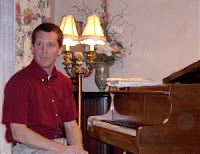 But my goal of all this was to be able to play piano again in public on demand. And my target was Christmas. Well, today is December 22... and yesterday I played in a little Christmas recital at the home of a friend who teaches. I think that counts for "in public", even if the public was pretty small.
I performed two pieces: a Chopin Étude (Opus 10, Number 3) and a piece from Isaac Albéniz' Iberia Suite (El Puerto). They're kind of challenging to play, but I think it went pretty well. I hope to record these two over the next couple of weeks and post the recordings on this blog.
Afterwards, the host of the recital suggested I might be able to perform at one of the upcoming recitals at a music school she's involved with here in Austin. If it works out, I might be able to find leads to other recitals, too.
Hm... better get back to practicing!
 But my goal of all this was to be able to play piano again in public on demand. And my target was Christmas. Well, today is December 22... and yesterday I played in a little Christmas recital at the home of a friend who teaches. I think that counts for "in public", even if the public was pretty small.
I performed two pieces: a Chopin Étude (Opus 10, Number 3) and a piece from Isaac Albéniz' Iberia Suite (El Puerto). They're kind of challenging to play, but I think it went pretty well. I hope to record these two over the next couple of weeks and post the recordings on this blog.
Afterwards, the host of the recital suggested I might be able to perform at one of the upcoming recitals at a music school she's involved with here in Austin. If it works out, I might be able to find leads to other recitals, too.
Hm... better get back to practicing!
Saturday, January 19, 2008
Piano 101: 4. Danza del Viejo Boyero
Or Dance of the Old Cowherd, although I can't imagine anybody dancing to this piece, much less an old cowherd.
Viejo Boyero is the first of three pieces that make up Alberto Ginastera's Danzas Argentinas. These three were among the last pieces I studied with Douglas Voice.
Listen for the six long notes at the end: they're the notes of the six open strings of a guitar.
Track 4: Danza del Viejo Boyero (Alberto Ginastera)
Viejo Boyero is the first of three pieces that make up Alberto Ginastera's Danzas Argentinas. These three were among the last pieces I studied with Douglas Voice.
Listen for the six long notes at the end: they're the notes of the six open strings of a guitar.
Track 4: Danza del Viejo Boyero (Alberto Ginastera)
Sunday, March 23, 2008
Piano 101: 7. Arabesque I
Debussy's Arabesque I was probably the first piece I learned that you'd consider "concert repertoire". It must have been around 1982 or 1983, I think. The piece is an example of French Impressionist music, known for its suggestion of atmosphere. But I had a lot of trouble trying to capture the tranquility and mood in a recording. Nonetheless, it's one of my all-time favorite pieces to play. It feels like making music.
Track 7: Arabesque I (Claude Debussy)
Track 7: Arabesque I (Claude Debussy)
Friday, March 7, 2008
Piano 101: 6. Danza del Gaucho Matrero
The final Argentinian Dance is the Dance of the Cunning Cowboy. The opening instruction on the score is "Furiosamente ritmico e energico" ("furiously rhythmic and energetic"), and it doesn't let up from beginning to end. You really have to work out how to keep the energy up without hammering on every note, because your arms won't make it to the end. I've found that stressing the inner voices in the big chords gives power and brings out the melody while avoiding exhaustion.
There are plenty of examples of the 2x3 vs. 3x2 rhythm throughout, as well as a new twist in the chordal melody sections where Ginastera inserts some bars of 9/8 among the 6/8. That adds a 3x3 grouping to the mix. There are a few other bizarre accent patterns that can completely throw your timing if you're not careful.
Anyway. Strap on your seatbelt...
Track 6: Danza del Gaucho Matrero (Alberto Ginastera)
There are plenty of examples of the 2x3 vs. 3x2 rhythm throughout, as well as a new twist in the chordal melody sections where Ginastera inserts some bars of 9/8 among the 6/8. That adds a 3x3 grouping to the mix. There are a few other bizarre accent patterns that can completely throw your timing if you're not careful.
Anyway. Strap on your seatbelt...
Track 6: Danza del Gaucho Matrero (Alberto Ginastera)
Wednesday, January 30, 2008
Piano 101: 5. Danza de la Moza Donosa
The second of Ginastera's Argentinian Dances is the Dance of the Graceful Maiden. And I LOVE this piece... the close chromaticism in the melody... the wide open intervals in the harmony.
There isn't a lot of rhythmic action, but a classic accent figure from Spanish music appears a couple of times. The 6/8 bars are mostly accented 1-2-3-1-2-3 but Ginastera occasionally throws in a bar accented 1-2-1-2-1-2. The most obvious examples are at 1:29 and 2:01. You can hear the effect by reciting this little poem:
Muffin with Marmelade
Muffin with Marmelade
Muffin with Marmelade
Muffin Muffin Muffin
This figure also appears all over the place in Albéniz' El Puerto and in the other two Argentinian Dances.
Track 5: Danza de la Moza Donosa (Alberto Ginastera)
There isn't a lot of rhythmic action, but a classic accent figure from Spanish music appears a couple of times. The 6/8 bars are mostly accented 1-2-3-1-2-3 but Ginastera occasionally throws in a bar accented 1-2-1-2-1-2. The most obvious examples are at 1:29 and 2:01. You can hear the effect by reciting this little poem:
Muffin with Marmelade
Muffin with Marmelade
Muffin with Marmelade
Muffin Muffin Muffin
This figure also appears all over the place in Albéniz' El Puerto and in the other two Argentinian Dances.
Track 5: Danza de la Moza Donosa (Alberto Ginastera)
Subscribe to:
Posts (Atom)


 Posts
Posts


