Saturday, December 5, 2009

Video: Chopin--Etude Op.10 No.3

One of my favorite pieces to play and I finally got around to video taping it.

I'm starting to think that maybe the conversion to Flash video used by both Vimeo and YouTube just can't handle audio well. In this case YouTube seems even worse than Vimeo, but both introduce some nasty distortion. I'll post .wma files (like I did for Maiden) so that there's an accessible version of decent-quality audio. I think if you download the .wmv from Vimeo, you'll also get decent audio.

Chopin: Etude Op.10 No.3 from Ken Barker on Vimeo.

Saturday, November 28, 2009

Video: Soler--Sonata No.84

Ok, I'll admit it: I have a strong bias toward Romantic composers. But I've made an effort to diversify a little by bringing more Baroque and Classical pieces into the mix. This piece is a keyboard sonata by late Baroque Spanish composer Padre Antonio Soler.

Soler was a monk, musician and composer, of course. But he was also an inventor, mathematician and author.

I hear Sonata No.84 as "light and playful", though the recent trend for this piece seems to be "as fast as humanly possible".

Now. With respect to the video... I've been fiddling with this for several days. Both Vimeo and YouTube seem to be converting the file to a Flash video with some nasty audio artifacts. But I've decided I'm going to have to live with it. If you're hearing distortion, you can download the .wmv file from the Vimeo page. It should be clean.

Soler: Sonata No.84 from Ken Barker on Vimeo.

Saturday, November 21, 2009

Video: Rachmaninoff--Prelude Op.23 No.5

Somebody asked me last year if I played any Russian music, and I realized that I had never studied any of the great Russian composers. So I started listening to a bunch and decided on this Prelude by Rachmaninoff. It's shortish, popular and fun to play: exactly what I'm looking for in new pieces to learn.

This performance is from the ConcART recital, which I decided to video tape this year. I was happy with the performance, mainly because I didn't trainwreck. Sure there are clams aplenty, but I thought it came off pretty well anyway.

The audio, on the other hand, is horrendous. It's taken from the camera's on-board mic, which is bad enough. But the camera also has a built-in compressor which can't be turned off. So when you hear the high-pitched whine/buzz, that's the compressor trying to make the soft parts as loud as the loud parts. Ugh. You'll just have to take my word for it that I had some nice soft passages in there.

As usual, you can watch in full HD at the vimeo page.

Rachmaninoff: Prelude Op.23 No.5 from Ken Barker on Vimeo.

Tuesday, November 17, 2009

ConcART II Review

I'm happy to report that this year's art show/recital was a success. The demographics were similar to last year: 50 people came in time for the recital and another dozen or so showed up later in the afternoon. Johanne sold 12 paintings to friends, neighbors, and even to other artists and a couple of guests of guests that we didn't know.

Welcoming our guests

I played a program of six pieces. I put quite a bit of thought into selection and sequencing of pieces, and I think it paid off. Several people commented on how interesting and varied the program was. And like last year, they really appreciated the little stories I gave to introduce each piece.

Playing the piano

I was disappointed not to have photographic proof of applause from last year. So this year I made sure to document it. Everyone seemed happy to accommodate, even through my low battery scare.

Proof of applause

Here's what it looked like from my angle.

From the "stage"

And even with about sixty people milling throughout the afternoon, we still way over-bought on food and drink. I guess that's why it's important to buy stuff you like: you're going to be finishing it for the next two months.

Looking at art

Once again, I'd like to thank several people for making ConcART II run smoothly:
  • Gary for tuning the piano and working on the hammers two weeks before the recital, and then coming back to put on a hard tuning two days before the show
  • Libby and Annabel for handling art sales
  • Laura for protecting the doors during the recital and for kenneling Maple dog for the day
  • Debie for monitoring the refreshment stations
All-in-all I'd have to say that this year's event was even better than last year's. Now to get to work on next year's party. What should I play?

Saturday, November 7, 2009

Granados: Laments or The Maiden and the Nightingale

Yesterday my father underwent (successful) coronary artery bypass graft surgery. In preparation for the tedium of convalescence, he bought himself an MP3 player. Among the 50 albums he loaded, he included the Piano 101 recordings. But he noted that some of the pieces that I made videos for aren't available as audio recordings. So I went back to the original audio files for those videos and encoded .wma files for downloading. Listening to them without the visual distraction of video, I was pleasantly surprised by the quality of the recording. And they capture the tone of my piano nicely. So I decided to post some of them here.

I've mentioned before that Enrique Granados' Goyescas suite is pretty much the pinnacle of piano music for me. The fourth piece in the suite is Quejas ó la Maja y el Ruiseñor (Laments or the Maiden and the Nightingale). And if you were wondering why people learn to play the piano, Maiden is a pretty good answer.

It's been a little under a year since I recorded this and I find the performance a little dry and plodding. But is it good enough to post to a blog with three readers? Most probably!

Quejas ó la Maja y el Ruiseñor (Enrique Granados)

Tuesday, November 3, 2009

ConcART II

If you've been reading this blog for a while, you may remember Johanne and I had a combination art show/piano recital last fall. We enjoyed it so much we decided to try to have one once a year. Well, the time has come! ConcART II will take place Sunday, November 15, 2009.

Johanne will be showing the pastel paintings and oil studies she's done this year, as well as a few older paintings that won awards in 2009.

To kick off the show, I'll give another recital of classical piano music. I wanted to mix things up a little this year. Last year's recital was very heavy on Romantic and Spanish music. I think this new program is more varied, and maybe a little more accessible.
  1. Twelve Variations on "Ah, vous dirai-je, Maman" (Wolfgang A. Mozart)
  2. Etude Op.10 No.3 (Frederic Chopin)
  3. Sonata No.84 (Antonio Soler)
  4. Arabesque I (Claude Debussy)
  5. Danza de la Pastora (Ernesto Halffter)
  6. Prelude Op.23 No.5 (Sergei Rachmaninoff)
If you can make it to Austin November 15, let me know and I'll send you the Evite.

Saturday, October 10, 2009

Transfer Function, What's Your... uh... Function?

Having a good mental model of how an unfamiliar piano responds helps you know how to adjust (or not adjust) your playing. For example, if a piano's action seems relatively stiff, you might be more careful to avoid notes not sounding. If a piano is voiced more brightly than you're used to, you might want to beware the tendency to underplay to compensate.

Both of these examples illustrate the importance of sensing how effort applied translates to sound out. I think of this relationship as a Transfer Function: different amounts of energy in (effort applied) produce different changes in energy out (volume, roughly). When playing an unfamiliar piano, if you can build a mental model of this transfer function, you're more likely to be able to exploit its dynamic range effectively. It's also easier to avoid overplaying a piano whose sound is smaller than what you're used to or underplaying a piano whose sound is bigger.

The graph below shows how energy out might vary depending on how much energy goes in for three hypothetical pianos.
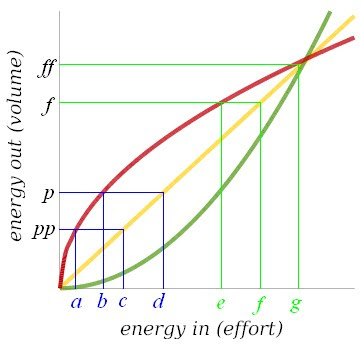
The yellow curve is the transfer function for a hypothetical "linear" piano, where doubling the effort produces exactly double the volume over the entire dynamic range. The red line would be a piano where small changes in effort produce larger changes in volume at the soft end, but more effort is required to produce changes in volume at the loud end. For example, a small increase in effort (from a to b) might be required to go from pianissimo to piano, whereas a large increase in effort (from e to g) might be required to go from forte to fortissimo. The green curve represents the transfer function of some wacky imaginary piano where the louder it gets, the easier it becomes to play even louder.

Real pianos would have transfer functions more like the red curve. Eventually, the curve flattens out to the right, meaning that as you hit the keys ever harder, you don't get much more volume.

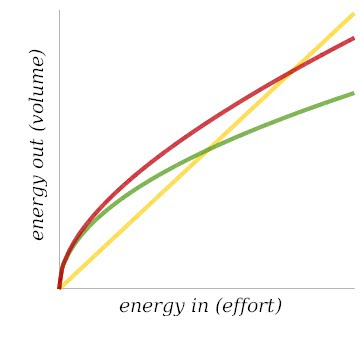
The next graph shows how transfer function might account for differences in big pianos versus small pianos. One of the most surprising things when playing concert grands, for example, is how they continue to respond dynamically at the loud end. That is, even when playing loud, the piano has power to get even louder. The transfer function of smaller pianos flattens out faster than that of larger pianos. In the graph below, the red curve would be a larger piano, the green curve a smaller piano.
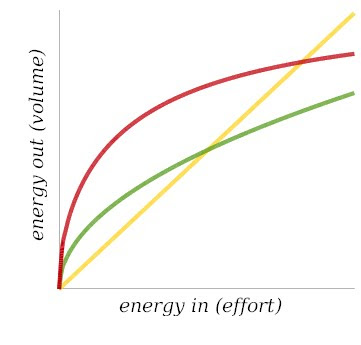
Any given piano may have a unique shape to its transfer function. The red curve in the graph below represents the transfer function for a piano that requires little effort to get from piano to forte, but then flattens out quickly. On such a piano, the risk to the player is in reaching high volumes with little effort, but then having no headroom left for louder passages. The tendency then would be to over-exert on loud passages, which can affect clean technique and result in fatigue. Keeping a model of this piano's transfer function in mind while playing would remind you that wide dynamic variation requires little change in effort in the soft and middle dynamic ranges, that forte comes easier than expected, and you should be careful not to hit the flat part of the curve before the loudest passages of the piece.
Sunday, October 4, 2009

Action!

I was excited by the title of a recent post on the Dallas Steinway blog: The Importance of Good Action on Pianos. I guess I was expecting a technical article about the motion and interaction of elements of a piano's action and how they affect playing. But the article seems more aimed at piano buyers, with the message: "don't be put off by a firm action... it's good for you".

The reason for my excitement (and disappointment) is that I spend a lot of time thinking about how pianos sound and feel. And I think there's more to action from a player's point of view than just "firm or not firm". So why not write about it on my blog?

When a piano requires relatively more energy to play, people often describe its action using words like "heavy", "stiff", "firm", etc. But I've played lots of pianos that felt "heavy but loose", or "light but stiff", suggesting there's more than one dimension. So here are the elements I think of when describing a piano's action:
  1. Weight (heavy vs. light)
  2. Stiffness (stiff vs. fluid)
  3. Tightness (tight vs. loose)
  4. Response (responsive vs. sluggish)
These may or may not map simply to physical differences in the machinery of the action. And they're all closely related to the subjective perception of how effort produces sound. I think of this effort-in-to-sound-out as a kind of Transfer Function, which I'll describe in another post. For now, I'll say a little more on each of the four elements.

I see weight as a perception of how much matter it feels like you're moving when you press a key. This may correspond to the actual weight of the moving pieces. It may also be affected by a sense of inertia (how much effort it takes to get things moving, and how much it feels like they keep moving once in motion).

Stiffness to me seems more similar to friction. How fluid is the motion of the key? The action can be stiff but light (like pushing an empty cardboard box across a table), or heavy but fluid (like pushing a heavy stone across ice).

The tightness of an action is more about the amount of extraneous motion. The motion can be lateral (for example, extraneous side-to-side motion if the guide pin is too loose in the bushing) or vertical. Two kinds of vertical looseness are excessive bounce on key-up and excessive mushiness at the bottom of the key bed. It's easy to imagine an action being heavy or light and loose, and fluid and loose. I'm not sure I can imagine stiff and loose.

For me, the response of an action is about the perceived directness of the connection between motion and sound. More than the other elements, response seems temporal to me. Is there a feeling of delay in the action? How quickly are notes available for repetition? Does the key motion seem synched with the note sounding (especially when playing softly)? Informally, does the piano do what you want it to without hesitation?

So where do various pianos stand on the four dimensions? I'd say the action on my piano (an Essex 183) is medium-weight, somewhat stiff, nice and tight, and extremely responsive. The Steinway D I played at my last recital was fairly heavy, but fluid and a little loose, making it feel overall a little sloppy to me (the lack of stiffness and tightness failing to hold the inertia of the heavy action in check).

Of course, all of these perceptions are in the context of how the piano produces sound in response to force exerted, which is the topic of my next post.

Sunday, August 16, 2009

A Pilgrimage

I just got back from a week in New York for work. For the first half of the trip I was staying at the Millennium Broadway Hotel, which is in midtown Manhattan, right in Times Square. When I learned I was going to be spending time in Manhattan, I knew there were two things I had to do while there: 1) run Central Park; 2) visit Steinway Hall.

The reception area of Steinway Hall, NYC

Steinway Hall is on West 57th St., just a half a block from Carnegie Hall. The reception area inside the entrance is a large, two-story domed room with a D sitting right in the middle (see the photo). I failed to surprise the receptionist by saying I was on a pilgrimage from Texas. She had me sign in and pointed me to the five rooms off the hallway leading from the back of the reception room. The salespeople at the desks around the outside of the room appeared not to notice my intrusion.

The piano rooms were more old mansion than store showroom. Each had several Steinway grands, mostly As and Bs. And there seemed to be very few stock pianos: most were from the Crown Jewel Collection, with some combination of scrollwork music rack, retro fallboard lettering and exotic wood. I plinked a couple of notes on each, trying to find the piano that was expecting me. The closest I came was a Macassar Ebony B. Unfortunately, a piano tech was tuning in the adjoining Boston room, so I continued on down the hallway.

The room at the end of the hallway was the largest and housed several stock As, Bs, Os and a couple of Ms and Ss. One of the As insisted I play it, so I carried over the lone bench and pretended I was Enrique Granados. The action was gorgeous and the dynamic range was shocking. Unfortunately, the cubic shape of the large room and the tiled floor made the room much too live for my tastes. Rather than cry about it, I found a brighter A in the center of the room and blasted out some Rachmaninoff. The room may still be echoing.

I had read that there were two other floors of pianos and wanted to explore a bit more. So I returned to the entrance only to find the receptionist's desk empty. The salespeople continued their theatrical display of not noticing me, even though I was the only other person in the room. So I wandered over to the staircase and went up to the second floor. I was somehow met by one of the previously uninterested now suddenly very interested salespeople. He told me that guests aren't normally allowed upstairs unescorted. Taking this as an offer to escort me, I asked to see the second-floor rooms and pianos.

We started our tour in the Artist Room, whose walls are covered with portraits of Steinway Artists. I immediately picked out Alicia's photo. We then went on to the large room at the end of the hall, where they keep the concert Ds and Bs. The salesman started probing a little, so I told him my story: how I became infatuated with an A out of my league, had a brief affair with a Boston 215 and ultimately found true love in my Essex 183. He conceded that the 183 was a nice piano, if not an A. They don't stock many of the larger Essex and Boston because people who shop for pianos on W57th are usually there for a Steinway (even if their piano needs are for something 7-feet and black for the empty space in the living room).

I think at this point we both sensed mass was over. I didn't play any Ds, but I had seen more beautiful Steinways than you can shake a topstick at. And playing those two As in the home of Steinway was an absolute joy. Next time I'll have to think up a story that will get me into the Concert Bank.

Tuesday, July 28, 2009

How Many Dampers does a Piano Have?

I've played a lot of pianos. But it never occurred to me to think much about how many dampers there are.

Dampers are felt-bottomed wooden blocks that lift off a key's strings when the key is depressed, allowing the strings to vibrate. The damper then drops back on to the strings when the key is released, stopping the strings from vibrating. Each key on the piano has a damper, except for the highest few keys. I always assumed the highest keys didn't have dampers because their sustain wouldn't interfere unpleasantly with the music (either because they have less sustain or for some psycho-acoustic reason, dunno).

But I never noticed where the dampers stopped until I got my own piano. My Essex EGP-183 has 71 dampers. That means the last damper is on the G6 key. I noticed that some of my pieces sounded a little funny in the upper register. So I started looking at the other pianos I play. The nine-foot Steinway D has 71 dampers. But all of the other Steinway grands I play (M, L and B models) have 67 dampers (ending at D#6). And all the Yamaha grands I know have 69 dampers (ending at F6).

The dampers on an Essex EGP-183 go up to G6; no dampers on G#6-C8

So what difference does it make?

Turns out I play two pieces that have passages that climb up to exactly G6 and stop there, followed by rests. On most pianos, that means the G rings out over the rests. But on my Essex, the G stops dead.

G6s at the end of Ginastera's Danza del Viejo Boyero

Luckily, it's easy to hold the G6 with the right hand pinky and come off the other right hand notes dry. And I really prefer the sound (probably because I played the Ginastera for many years on pianos with no G6 damper and I'm used to that sound).

G6 at the end of Rachmaninoff's Prelude Op.23 No.5

The Rachmaninoff is a different story: I've only ever played it on my Essex. But that ending sounds really dry to me. If I hold the G6 with the pinky and take both the G3 and G4 in the left hand, it sounds "right" to me. (In most recordings, the room is live enough that the note sustains, damper or not).

So how's that for minutia?