Sunday, May 30, 2010

Happy Second Pianoversary

Today marks the second anniversary of the delivery of my piano. I can't even imagine life without it. In two years it has starred in 18 videos and audio recordings, it's shown itself in two recitals to 100 people, it's learned about 25 pieces, and it practices almost every day (I assume it doesn't play when I'm out of town).

It's been tuned 10 times, voiced twice, had its shanks fired, been tweaked, lubricated and adjusted. It's been covered on three occasions and wiped down 700 times. It has been played by two people.

It has never had a cat inside of it, although this is not thanks to any great self-restraint on the part of the cats. I've never touched its case with my bare hands, but I think today I will.

Happy Birthday, piano!

Saturday, May 29, 2010

So That's What It Sounds Like

I've had my piano for two full years now. But believe it or not, I've never heard it played (I'm always the one playing it). I've invited others to play it, but have never had any takers until last weekend.

My neighbor's father is a fairly advanced pianist, and we talk about repertoire pretty regularly, but he's never taken me up on offers to play my piano. Last Saturday after dinner Johanne and I were out throwing a football in the street when he came out with his grandson to see the football. After chatting for a few minutes Johanne invited him to try the piano again and this time he took us up on it.

He played parts of Schumann's Carnavale and Mendelssohn's Songs Without Words, and even the first page of Liszt's arrangement of Schumann's Widmung, which was really fun because that's a piece I play too. I couldn't stop smiling, hearing my piano for the first time. And it's amazing how rich and full it sounds from "out front", even though its unisons are horribly out right now. I can't wait to have him back when it's tuned so I can hear it at its best.

Sunday, May 2, 2010

Video: Ginastera--Danzas argentinas (HD)

The pieces I posted in the last three blog entries are often (usually?) performed together as one big work: the Danzas argentinas. I wanted to do the same with my video: have one continuous performance/video of the three dances together. (The individual videos posted last month were actually edited down from the full-length video). So this week I'm posting the complete video.


Sunday, April 11, 2010

Video: Ginastera--Danza del gaucho matrero (HD)

Here, finally, is the third piece of Alberto Ginastera's three Danzas Argentinas. This is The Dance of the Arrogant Cowboy. It's not a remake like the other two, because I never got around to recording it when I first recorded the others.

Listening to the performance, it occurs to me that I approach videos and recitals quite differently. For recitals I think energy and expression are more important than cleanliness. People take away the big picture more than the details. But in a video the details are much more noticeable. And permanent! So I think my video performances are a little more conservative. That is certainly the case here. Comparing it to the hundreds of other videos of this piece you can find on the web, my performance here is quite clean, but maybe not as fiery as some.

Saturday, April 3, 2010

Video: Ginastera--Danza de la moza donosa (HD)

Here is my HD remake of Danza de la moza donosa (Dance of the Graceful Young Maiden), Ginastera's second piece from the Danzas Argentinas. It's my favorite of the three dances. And although I think the performance is quite a bit better than the old SD version, I still find it just a little lackluster. Will I ever really love one of these videos? Maybe not.

The video itself is part of one long video of all three dances, so the visual similarity to this blog's previous installment is not coincidental. I guess I'll post the long, complete thing after the third dance.

So, no further ado, etc.


Sunday, March 28, 2010

Video: Ginastera--Danza del viejo boyero (HD)

Welcome to the second in the Ripoff Series of videos (videos of pieces that I've posted videos of before). My first stab at filming this piece was exactly 18 months ago. And not only was it crappy SD, it was crappy mono audio. Mono audio!

I think the audio is pretty good on this one. I'm still learning and improving. And I'm still getting used to my new camera, and experimenting a little more in video post-production. Video experts will no doubt cringe at my heavy hand on the levels.

When I blogged about the original video in September, 2008, I promised (?) that I would do videos of the second and third Argentine dances, too. I did manage to post a pretty terrible performance of the second one, but not the third. This time there is no risk that I'll renege. The second and third are already "in the can". I have a little editing to do before I can post them, but they'll be online in the next couple of weeks.

So here is the HD/stereo remake of Alberto Ginastera's Danza del viejo boyero, the first of the Danzas Argentinas.

Sunday, March 21, 2010

Video: Beethoven--Pathétique Sonata, 2nd Movement (HD)

Ok. I know what you're thinking: "What a ripoff! We already have a video of this piece!" It's true. But this is a better video. I'm going back and redoing all my earliest (SD) videos in HD.

The SD/HD cutoff also (coincidentally) marks the line between what I think are the worse performances and the better performances. My goal is to have decent performances on HD for all of the pieces in my repertoire. The videos I need to redo are the Beethoven, Liszt, Albéniz and Ginastera.

This video is also my first video with the new camera Johanne bought me for my birthday! It's a Canon SX1 IS. The camera is in the category they call "superzooms", a bit of a misnomer for cameras that are halfway between point-and-shoot and SLR. They have most of the flexible manual controls of an SLR, significant glass and an internal viewfinder. But the lens is not interchangeable and the viewfinder is an internal LCD (as opposed to a mirrored view through the lens). Among the superzooms, the Canon has the best video features for me (full 1080 HD, full swivel on the LCD, manual focus and exposure locking, and a remote control).

My New Canon SX1 IS

The video quality is great when there's enough light. Here, the video seems a bit noisy, especially if you look at the darker areas. I'll have to keep experimenting with light, settings, etc. But you can't believe how great it feels to be released from the shackles of digital video tape. I'll never go back.

Beethoven: Pathétique Sonata (2nd Movement) from Ken Barker on Vimeo.

Sunday, March 14, 2010

Happy Repertoire Season

Hello Blog.

Well, it looks like I let February go by without a single post. Shame on me. The good news is that the blog going dark doesn't mean I've been ignoring music. Au contraire, I'm in the middle of a busy "repertoire season". This is the time of the year for me to be learning brand new pieces to add to my repertoire. Immediately after the late-Fall ConcART, I like to start planning a new program, and that means finding new pieces to play.

I usually hunt around YouTube for pianists I like and composers I'd like to try. If a piece jumps out at me I'll go get the manuscript from the library at UT and spend a week or so reading it and trying it on for size. And if it survives reading week, I order my own copy of the music.

Right now I'm working up four brand new pieces by Johannes Brahms, Manuel de Falla, Robert Schumann (arranged by Franz Liszt) and another new Spanish discovery: Joaquín Nin-Culmell. I realize it's a bit pretentious of me to claim him as a discovery, but when there's only one recording on YouTube, I think that counts as a discovery. I'm also resurrecting an old George Frideric Handel.

The Handel, Falla and Nin-Culmell are already memorized and up to speed. I'd say they're "performable" (given adequately loose performance standards). The Brahms is memorized but not up to speed. It's definitely not at performance, but it will be. The Schumann/Liszt is still in the earliest stages of learning.

Counting everything except the Schumann/Liszt, my memorized repertoire sits right now at twenty: Albeniz, Bach, Beethoven, Brahms, Chopin, Debussy, Falla, Ginastera (×3), Granados (×2), Halffter, Handel, Liszt, Mozart, Nin-Culmell, Rachmaninoff, Schubert and Soler.

Happy Repertoire Season!

Sunday, January 31, 2010

How to Film a Piano from Above

I promised that I would write a blog post on how I got the overhead piano shots in my last video.
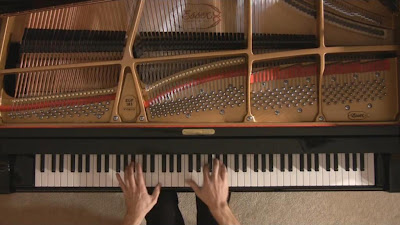
The problem is that it the camera needs to be directly above the piano and high enough to use a longish focal length (to avoid fisheye distortion of the straight horizontal lines of the piano). You can't just use a normal tripod... it would have to be a really tall tripod with a long boom arm.

But this is exactly the kind of puzzle Johanne and I like to work through over Sunday morning coffee. We put our heads together and came up with a pretty simple solution.

We have ten-foot ceilings, so there's definitely enough room to get the camera high enough. We gave up on the idea of stands and booms right away, which left fixing the camera to the ceiling. Johanne came up with the idea of a T-track like the tracks in power tool tables that let you fix jigs, fences, etc. to the table. The track itself is in the shape of a C, which gives it a T-shaped slot. You slide a T-bolt into the slot, place your object (with a hole in it) over the T-bolt, then tighten it down with a knob.

So we installed a short length of T-track on the ceiling above the piano:
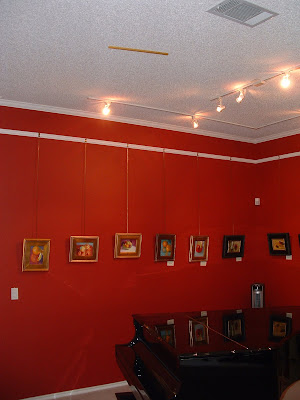
Gold T-track fixed to ceiling above the piano

In the zoomed-out photo, the gold T-track above the piano just looks like a gold line on the ceiling. Zooming in, you can make out the C-shape of the track forming a T-slot:
T-track on the ceiling

To fix the camera to the T-track, we bought a simple L-bracket. We fix one arm of the L-bracket to the T-track with a T-bolt and a knob:
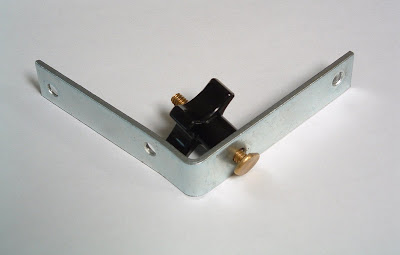
T-bolt passing through the L-bracket

The T-shaped head of the T-bolt slides into the slot of the T-track. Tightening the knob fixes the L-bracket to the T-track. Using a single bolt allows us to rotate the bracket under the T-track to get it perfectly square with the piano keyboard. We attach the camera to the other arm of the L-bracket using a 20-1/4" knob bolt, which is one of the standards for camera tripod mounts:
Camera attached to the perpendicular arm of the L-bracket

A thin piece of wood keeps the L-bracket from marring the camera and prevents the knob bolt from bottoming out in the camera's tripod mount. The camera can swivel on the L-bracket to make sure the focal plane is parallel with the keytops (to avoid trapezoid distortion).

Simple! I bought the T-track, T-bolt, knob and 20-1/4" knob bolt at Woodcraft, and the L-bracket at Lowe's. Total cost: about $15.
Saturday, January 16, 2010

Video: Schubert--Impromptu Op.90 No.4

Here is another piece that I didn't really plan on adding to the repertoire. I only intended to learn it well enough to record it back in Spring 2008 as a surprise for my mother. As I wrote on the blog back then:
Schubert's Impromptu is a piece that my mother used to play. Some of my earliest memories are of her playing it on her old Chopin upright piano. I couldn't have been more than four or five years old. But it was one of the pieces that got me interested in learning the piano and has stuck with me all these years.
But I found that I really enjoyed playing it, and it was close enough to performance level to work it up for the first ConcART in October, 2008. These days I probably run through it at practice once or twice a month. That seems to be enough to keep it "ready".

The piece itself is a little deceptive. There's nothing obviously difficult about it. But keeping the right hand "waterfalls" light and even is very technically challenging. This recording shows that I still struggle with the evenness. That's also what makes it risky to play this piece on an unknown piano. If the action isn't responsive enough you're in for a hot, gooey mess.

I continue to push my experimentation with the video, here. I'm finding that mixing up different camera angles adds to the interest of the video, making it easier to sit through the whole thing. (I'm also finding that it's important to plan the angles/switches instead of just jumping around between them randomly). One of my favorite camera angles in professional videos is the direct overhead shot. But it's not an easy shot to get: how do you get the darn camera up there? And it has to be high enough to get the whole keyboard without fisheye distortion. Anyway, I batted some ideas around with my personal problem solving expert (Johanne) and we came up with a nice solution. I'll write a separate blog post about it soon.

Schubert: Impromptu Op.90 No.4 from Ken Barker on Vimeo.