
Sunday, May 31, 2009
Happy First Pianoversary
I thought I should celeblog the first anniversary of the delivery of my piano. It was one year ago yesterday (May 30) that it arrived. I play it every day and love it more than ever. It's been a dream come true. Here's to you, piano!

Wednesday, May 20, 2009
Impromptu Recital
My good friends Bruce and Claudia Porter saw their youngest (Ben) get married last Saturday. Johanne and I went to the wedding, which was held at The Mansion in Austin. It was a great ceremony, dinner and party and we're really happy for Ben and his bride Alejandra Rodriguez. (As an aside, Alejandra, who goes by "Ale" for short, has just inherited the best beer name ever: "Ale Porter").
The Mansion, as you'd expect, has several big rooms with pianos. They have a little Hardman baby grand (one of the huge cast of decent early twentieth century American piano makers). Another room has a Steinway M or L (couldn't quite tell which just looking at it -- it was old enough that the model stamp wasn't in the usual place and the L is only 3.5" longer than the M). But the star is a Baldwin SD10 9' concert grand. The photo shows the actual piano in its room at The Mansion.

After the bride and groom left, we were standing around and somebody suggested that it wasn't too late for me to check out the SD10. So a few of us went in for an impromptu recital. I played Ernesto Halffter's Danza de la Pastora, Alberto Ginastera's Danza del Gaucho Matrero and the second movement of Beethoven's Pathétique Sonata. It was late and I was tired, but it went well. My small audience insisted on one more, so I played Enrique Granados' Laments, or the Maiden and the Nightingale (Quejas, ó la Maja y el Ruiseñor).
Everyone seemed to enjoy the performance. As much as I did? Maybe. :-)
The Mansion, as you'd expect, has several big rooms with pianos. They have a little Hardman baby grand (one of the huge cast of decent early twentieth century American piano makers). Another room has a Steinway M or L (couldn't quite tell which just looking at it -- it was old enough that the model stamp wasn't in the usual place and the L is only 3.5" longer than the M). But the star is a Baldwin SD10 9' concert grand. The photo shows the actual piano in its room at The Mansion.

After the bride and groom left, we were standing around and somebody suggested that it wasn't too late for me to check out the SD10. So a few of us went in for an impromptu recital. I played Ernesto Halffter's Danza de la Pastora, Alberto Ginastera's Danza del Gaucho Matrero and the second movement of Beethoven's Pathétique Sonata. It was late and I was tired, but it went well. My small audience insisted on one more, so I played Enrique Granados' Laments, or the Maiden and the Nightingale (Quejas, ó la Maja y el Ruiseñor).
Everyone seemed to enjoy the performance. As much as I did? Maybe. :-)
Sunday, May 10, 2009
Spring Recital
I've mentioned here that I'd like to find more opportunities to perform. So I jumped when Steinway Guy asked me to play at a recital of his students on May 31. It's a great opportunity to play for a larger audience and I thought it would give me a chance to test-drive a couple new pieces. The recital will be at the Steinway Piano Gallery, hopefully on the D!
I asked SG if he had any preferences, or if there was an overall theme to the program. He said I could play anything I like. But then a few weeks ago he mentioned that it would be good if I could play something the audience would recognize. But not Für Elise or the Moonlight Sonata. And the pieces shouldn't be too long, since there will be a lot of kids in the audience. But they should be technically challenging to show the students what you can do if you practice your scales and technique.
Of course, I have nothing that fits all those criteria. And it seemed a little late to learn something brand new. But then it hit me! The Mozart Variations on "Ah, vous dirai-je, Maman" would be perfect. I've never really learned them, but I've noodled around with them enough over the years that I was confident I could put them together in time. I'll also play Pastora and Gaucho Matrero, which the audience surely won't recognize, but are short, fast and very entertaining.
I asked SG if he had any preferences, or if there was an overall theme to the program. He said I could play anything I like. But then a few weeks ago he mentioned that it would be good if I could play something the audience would recognize. But not Für Elise or the Moonlight Sonata. And the pieces shouldn't be too long, since there will be a lot of kids in the audience. But they should be technically challenging to show the students what you can do if you practice your scales and technique.
Of course, I have nothing that fits all those criteria. And it seemed a little late to learn something brand new. But then it hit me! The Mozart Variations on "Ah, vous dirai-je, Maman" would be perfect. I've never really learned them, but I've noodled around with them enough over the years that I was confident I could put them together in time. I'll also play Pastora and Gaucho Matrero, which the audience surely won't recognize, but are short, fast and very entertaining.
- Variations on "Ah, vous dirai-je, Maman" (Wolfgang Amadeus Mozart)
- Danza de la Pastora (Ernesto Halffter)
- Danza del Gaucho Matrero (Alberto Ginastera)
Tuesday, April 28, 2009
Video: Arabesque I
Claude Debussy's Arabesque I might be the "oldest" piece I play, in the sense that I've played it longer than the others. I think I first learned it in 1982. (I could probably recover the year if I knew what grade it was in the RCM syllabus).
Update 4/29/09: BJ says in the comments that it's Grade 10, which means I probably started learning it Fall, 1982.
I'm very happy with the audio on this recording. The video is ok. I might start experimenting with lighting and post-production image processing.
Again, to watch in HD, you'll have go to vimeo and watch it full screen (well worth it, says me).
Debussy: Arabesque I from Ken Barker on Vimeo.
Update 4/29/09: BJ says in the comments that it's Grade 10, which means I probably started learning it Fall, 1982.
I'm very happy with the audio on this recording. The video is ok. I might start experimenting with lighting and post-production image processing.
Again, to watch in HD, you'll have go to vimeo and watch it full screen (well worth it, says me).
Debussy: Arabesque I from Ken Barker on Vimeo.
Thursday, April 16, 2009
Video: Danza de la Pastora
Danza de la Pastora is a wonderful piece by twentieth century Spanish composer Ernesto Halffter. The piece was originally written as part of his one-act ballet Sonatina, but he also arranged it for solo piano.
I had never heard of Ernesto Halffter. Last Fall I was hunting around the web for Alicia de Larrocha recordings. She's one of my all-time favorite pianists, and is responsible for popularizing much of the Spanish piano repertoire. I came across a video on YouTube from an old 1967 documentary pairing Spanish art and music. The second performance is de Larrocha playing Danza de la Pastora. It completely hooked me from the first notes.
So I started trying to find out more about the piece and about Halffter. I could only find one recording of his piano works, a two-disc set by Guillermo González. The liner notes state that Halffter was "one of the most important Spanish composers of the twentieth century". I have plenty of respect for Halffter, and I'm completely crazy about Pastora, but I'm going to have to call BS on this one.
A note on the video... I'm definitely making some headway with the video quality. This is my first piano video in HD. You can play the embedded version below but you won't see it in HD. So make sure you go to my page at vimeo.com and watch it full screen. I should also note that YouTube now allows HD videos and stereo audio, so you can watch it HD at my YouTube page too.
Halffter: Danza de la Pastora from Ken Barker on Vimeo.
I had never heard of Ernesto Halffter. Last Fall I was hunting around the web for Alicia de Larrocha recordings. She's one of my all-time favorite pianists, and is responsible for popularizing much of the Spanish piano repertoire. I came across a video on YouTube from an old 1967 documentary pairing Spanish art and music. The second performance is de Larrocha playing Danza de la Pastora. It completely hooked me from the first notes.
So I started trying to find out more about the piece and about Halffter. I could only find one recording of his piano works, a two-disc set by Guillermo González. The liner notes state that Halffter was "one of the most important Spanish composers of the twentieth century". I have plenty of respect for Halffter, and I'm completely crazy about Pastora, but I'm going to have to call BS on this one.
A note on the video... I'm definitely making some headway with the video quality. This is my first piano video in HD. You can play the embedded version below but you won't see it in HD. So make sure you go to my page at vimeo.com and watch it full screen. I should also note that YouTube now allows HD videos and stereo audio, so you can watch it HD at my YouTube page too.
Halffter: Danza de la Pastora from Ken Barker on Vimeo.
Tuesday, April 14, 2009
Thom Barker Band: No Forever
The second TBB demo is a song that also made it on to Twice the Usual, though with a quite different feel.
No Forever
I'll post the version off 2x as well, for comparison.
No Forever (off Twice the Usual)
The most obvious difference is the tempo. The TBB version sits just under 150 bpm. The 2x version is 180! I like the faster tempo better, but I think the slower version would have worked if we had performed it more relaxed. As it is, it sounds like we're all fighting to hold it back.
To me the second most obvious difference is how warm the TBB recording sounds. That's the difference between a real recording studio and some schlub with a home studio. The 2x version sounds very harsh by comparison. The mix on the TBB version is better too. The bass sits in the lows and doesn't stray. The electric owns the mids, and the drums find the gaps. On the 2x version, everything is fighting for the mids.
Apart from that, I think we can all agree on what the recording really needs: more cowbell!
No Forever
I'll post the version off 2x as well, for comparison.
No Forever (off Twice the Usual)
The most obvious difference is the tempo. The TBB version sits just under 150 bpm. The 2x version is 180! I like the faster tempo better, but I think the slower version would have worked if we had performed it more relaxed. As it is, it sounds like we're all fighting to hold it back.
To me the second most obvious difference is how warm the TBB recording sounds. That's the difference between a real recording studio and some schlub with a home studio. The 2x version sounds very harsh by comparison. The mix on the TBB version is better too. The bass sits in the lows and doesn't stray. The electric owns the mids, and the drums find the gaps. On the 2x version, everything is fighting for the mids.
Apart from that, I think we can all agree on what the recording really needs: more cowbell!
Sunday, April 12, 2009
Thom Barker Band: All The Same To Me
The first of the two 1996 Thom Barker Band demos was All The Same To Me.
All The Same To Me
This song has all the elements of a classic Thom Barker song: happy-catchy music, despondent lyrics, hooky Chénier guitar themes, sloppy overplayed bass and horrible backing vocals.
The first thing that jumps out at me is how over-compressed the drums are. Sure, it makes them sound nice and punchy. And it was the '90s. But man, that's a lot of compression.
Second thing is Chris' electric theme. He has this knack for coming up with a hook that's completely original, but ends up defining the song. Underneath, the acoustic and bass just repeat I-vi-IV-V (the Heart and Soul chords... and a million other pop songs). Chris' hook gives it its own character.
The bridge (at 2:03) is a departure for a Thom Barker song. I can't think of another one like it. I'm pretty sure Thom had the idea of breaking down to a half-tempo version of the chorus. I think it was also his idea to switch to 6/8 time. I do remember working it out on my SY77 sequencer to show the band how to get in and out of it. We never quite got it right, though. We got into it ok, but tended to rush the half time a little. And the band was never really comfortable coming back out. You can hear in the recording that the outro chorus is a little slower than the beginning of the song. It's maybe 8-10 bpm (about 5%) slower. The highlight of the bridge for me is Chris' harmonic embellishments. Any time he accuses me of playing too many chord extensions I can point him here. Who's the jazz-head now, eh?
All The Same To Me
This song has all the elements of a classic Thom Barker song: happy-catchy music, despondent lyrics, hooky Chénier guitar themes, sloppy overplayed bass and horrible backing vocals.
The first thing that jumps out at me is how over-compressed the drums are. Sure, it makes them sound nice and punchy. And it was the '90s. But man, that's a lot of compression.
Second thing is Chris' electric theme. He has this knack for coming up with a hook that's completely original, but ends up defining the song. Underneath, the acoustic and bass just repeat I-vi-IV-V (the Heart and Soul chords... and a million other pop songs). Chris' hook gives it its own character.
The bridge (at 2:03) is a departure for a Thom Barker song. I can't think of another one like it. I'm pretty sure Thom had the idea of breaking down to a half-tempo version of the chorus. I think it was also his idea to switch to 6/8 time. I do remember working it out on my SY77 sequencer to show the band how to get in and out of it. We never quite got it right, though. We got into it ok, but tended to rush the half time a little. And the band was never really comfortable coming back out. You can hear in the recording that the outro chorus is a little slower than the beginning of the song. It's maybe 8-10 bpm (about 5%) slower. The highlight of the bridge for me is Chris' harmonic embellishments. Any time he accuses me of playing too many chord extensions I can point him here. Who's the jazz-head now, eh?
Friday, April 10, 2009
Thom Barker Band: The Recording
The Thom Barker Band recordings were done at the new Sound of One Hand Studios at their location on Liverpool Court (off Innes Road) in south Ottawa. It was after they moved but before they renamed to Liverpool Court Studios. We recorded in the big room and Marty Jones was the engineer. The photo clearly shows their new (used) Neve console.
 Marty Jones at the Neve
Both songs were straight guitars-bass-drums. Thom used his blue Yamaha acoustic and his yellow hair.
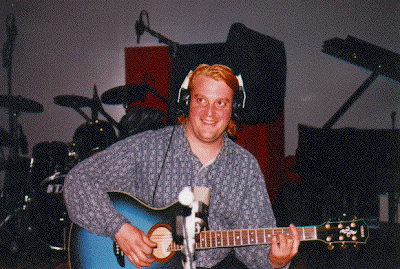 Thom at Sound of One Hand
I had recently upgraded to the John Pattitucci signature Yamaha six string bass (the TRB-JP). It's still my all-time favorite instrument with a single-digit number of strings. We recorded it direct through the good-old Sans Amp Bass Driver DI.
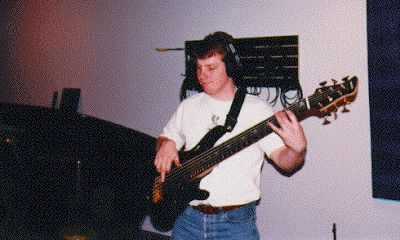 Ken at Sound of One Hand
Chris was still using his old Ibanez electric at the time. This was obviously before he developed full-on GAS (Gear Acquisition Syndrome). He tracked his parts from the control room, but the sound was mic'd off an amp in the big room. I remember us fooling with different amps (including the big Marshall in the picture and the smaller combo that Marty is messing with). I don't remember what amp we went with.
 Chris at Sound of One Hand
Scott was playing his basic Tama kit (with one anonymous rototom).
 Scott at Sound of One Hand
 Marty Jones at the Neve
Both songs were straight guitars-bass-drums. Thom used his blue Yamaha acoustic and his yellow hair.
 Thom at Sound of One Hand
I had recently upgraded to the John Pattitucci signature Yamaha six string bass (the TRB-JP). It's still my all-time favorite instrument with a single-digit number of strings. We recorded it direct through the good-old Sans Amp Bass Driver DI.
 Ken at Sound of One Hand
Chris was still using his old Ibanez electric at the time. This was obviously before he developed full-on GAS (Gear Acquisition Syndrome). He tracked his parts from the control room, but the sound was mic'd off an amp in the big room. I remember us fooling with different amps (including the big Marshall in the picture and the smaller combo that Marty is messing with). I don't remember what amp we went with.
 Chris at Sound of One Hand
Scott was playing his basic Tama kit (with one anonymous rototom).
 Scott at Sound of One Hand
Thursday, April 9, 2009
Thom Barker Band Promo Photos
In the Fall of 1995 when Thom was getting serious about promoting the band, he put together a "promo package" which included press clippings, the Forest cd, bios and promo photos. We had done up a couple of photos specifically for the promo package. I don't know what happened to the negatives or any of the prints. I assume they're probably lost forever.
 Thom Barker Band, Fall 1995, Regent St., Ottawa
But this was 1995 and there was a new craze sweeping Computer Science Departments. It was called the World Wide Web. It made it easy to publish text and pictures online in a way that was presentable for reading (as opposed to just searching and downloading). Not being immune to the draw of a bandwagon, I started scanning photos and putting them on web pages in my Unix account at the University of Ottawa.
Unfortunately, sometime in the late '90s I accidentally deleted all photos in my musicpix directory whose filename began with the letter 't'. Don't ask me why. So the scanned versions of the Thom Barker Band promo photos (tbb-promo1.gif and tbb-promo2.gif) and a bunch of others were gone.
Fast forward 14 years to April, 2009. Thanks to the magic of the Wayback Machine, I found the deleted photos. Sometime between 1995 and the date I deleted the pictures, the Wayback Machine archived them. I'm sure I've checked the archive before, but if you've ever tried to find old stuff there, you know it's kind of hit-or-miss. Today I got lucky.
 Thom Barker Band, Fall 1995, Regent St., Ottawa
 Thom Barker Band, Fall 1995, Regent St., Ottawa
But this was 1995 and there was a new craze sweeping Computer Science Departments. It was called the World Wide Web. It made it easy to publish text and pictures online in a way that was presentable for reading (as opposed to just searching and downloading). Not being immune to the draw of a bandwagon, I started scanning photos and putting them on web pages in my Unix account at the University of Ottawa.
Unfortunately, sometime in the late '90s I accidentally deleted all photos in my musicpix directory whose filename began with the letter 't'. Don't ask me why. So the scanned versions of the Thom Barker Band promo photos (tbb-promo1.gif and tbb-promo2.gif) and a bunch of others were gone.
Fast forward 14 years to April, 2009. Thanks to the magic of the Wayback Machine, I found the deleted photos. Sometime between 1995 and the date I deleted the pictures, the Wayback Machine archived them. I'm sure I've checked the archive before, but if you've ever tried to find old stuff there, you know it's kind of hit-or-miss. Today I got lucky.
 Thom Barker Band, Fall 1995, Regent St., Ottawa
Wednesday, April 8, 2009
The Thom Barker Band
Hold on to your hat, blogreader... you're in for a surprise. I have uncovered the long-lost Thom Barker Band recordings! And I've digitized them and cleaned them up for posting. But first, a little background.
 Thom Barker Band at The Pit, December 21(ish?), 1995
Shortly after we finished recording Forest for the Trees, Thom decided he wanted to go for more of a band concept, and to ramp up our performance schedule. He was used to doing solo shows and duos (with me). We added electric guitar (Chris Chénier) and drums (Scott McCulloch).
 Zaphod Beeblebrox, August 9, 1996
We rented a rehearsal studio in the basement of Irene's Pub in the Glebe (Ottawa) and booked a whole bunch of shows over the winter of 1995 and well into 1996.
 The Gluepot Pub, August 10, 1996
We also booked Sound of One Hand Studio (where both previous albums were recorded) and got the whole band in there to record two songs. I thought we had lost those recordings forever, but I found a cassette at my parents' house and brought it back to my studio in Texas where I was able to get a decent quality re-recording of them.
Stay tuned!
 Thom Barker Band at The Pit, December 21(ish?), 1995
Shortly after we finished recording Forest for the Trees, Thom decided he wanted to go for more of a band concept, and to ramp up our performance schedule. He was used to doing solo shows and duos (with me). We added electric guitar (Chris Chénier) and drums (Scott McCulloch).
 Zaphod Beeblebrox, August 9, 1996
We rented a rehearsal studio in the basement of Irene's Pub in the Glebe (Ottawa) and booked a whole bunch of shows over the winter of 1995 and well into 1996.
 The Gluepot Pub, August 10, 1996
We also booked Sound of One Hand Studio (where both previous albums were recorded) and got the whole band in there to record two songs. I thought we had lost those recordings forever, but I found a cassette at my parents' house and brought it back to my studio in Texas where I was able to get a decent quality re-recording of them.
Stay tuned!
Subscribe to:
Posts (Atom)


 Posts
Posts

